
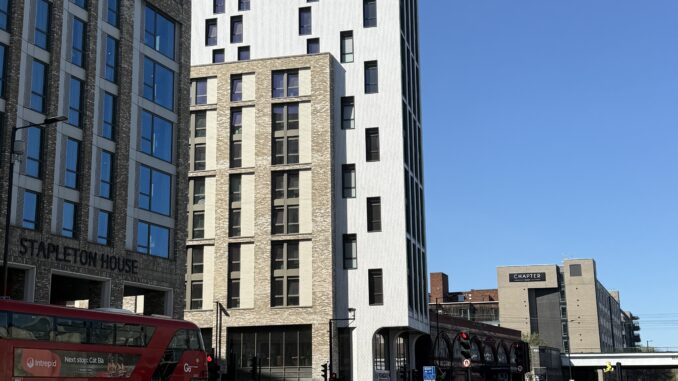
Student halls outside London Metropolitan University. Photo by Molly Madden
By Molly Madden
The cost of student accommodation in London has reached new heights, prompting growing concerns among university students and their families. With rent prices continuing to climb, many students are facing an uphill battle to secure affordable housing while pursuing their studies in London.
London has long been one of the most expensive cities for students, with rising rents across both private and university-run accommodation options. However, recent data shows a sharp uptick in prices, outpacing inflation and making it even more difficult for students from lower-income backgrounds to live in the city.
According to a report from the National Union of Students (NUS), the average rent for a student room in London has surged by nearly 10% in the past year alone, now averaging over £1,300 per month. This is significantly higher than other cities in the UK, where the average rent tends to be around £600-£800.
Many students are now spending more than half of their student loans on accommodation, leaving them with limited funds for essentials such as food and transport. And many are forced to work full-time to pay their living costs, which puts huge pressure on their studies.
Private vs Halls
While some universities have attempted to tackle the issue by providing more affordable on-campus housing, demand often exceeds supply. As a result, students are increasingly forced to turn to the private rental market, where prices are often even steeper.
The competition for affordable student housing is fierce, with many students left with few options but to pay inflated prices for subpar living conditions.
“I’m paying £325 a week for a flat that I have to share with five other people, including one tiny bathroom,” says Abhiraj Singh, a 21-year-old pre-med student at Queen Mary University of London. In addition to the multiple repairs he complained of, he mentioned the ongoing infestation of mice. “It’s the only place I can afford, but that doesn’t mean I should have to live with mice.”
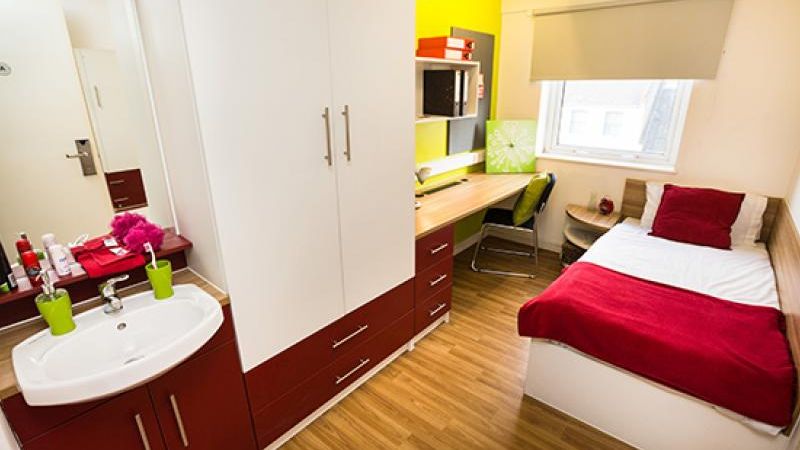
Standard room at IQ Arcade: A student hall on Holloway Rd. Credit: IQ Student Accommodation
In addition to high rent prices, students are also facing higher utility costs, maintenance issues, and overcrowded living spaces.
Zak Kadiyar, a computer science student at UCL, said: “I feel like I’m getting pushed out of London, I can’t afford to live near my university but it takes over an hour to get there on the tube.”
The reality of the situation is that many students are getting priced out of central London in search of affordable accommodation, forcing them to overcompensate with long tube journeys just to get to university. And with tube prices getting out of hand, it’s becoming an even greater financial burden.
Julia Grey, a London Metropolitan University graduate, moved to Manchester to pursue a graduate degree in international business. “I couldn’t afford London anymore without taking more loans,” she said. “I have so much more financial freedom in Manchester, I don’t have to worry about rent as much and can actually enjoy the city, which is something I couldn’t do as much in London.”
The impact of rising accommodation costs is not limited to the students themselves. University staff and education experts are raising alarms over the potential long-term consequences on the in-accessibility of higher education. Critics argue that these escalating living expenses are contributing to a widening social divide, with only students from wealthier backgrounds able to comfortably afford a London education.
Clamping down on costs
Some have suggested government intervention as a potential solution to curb the costs. The NUS (National Union of Students) is calling for the government to introduce rent controls for student accommodation in London, while others are advocating for the construction of more affordable housing for students.
“Higher education ranks as one of the public’s very lowest priorities for their vote, with people similarly unconcerned about related areas such as further education and apprenticeships,” said a report by The Policy Institute titled “The future of Higher Education”, published by Kings College London. The lack of interest from the general public allows politicians to ignore the issues of student affordability, projecting the strain further into the future.

A homeless woman, representing the ongoing housing crisis in London. Credit: Pixabay
As students in London continue to suffer through the housing crisis, the situation remains one of the most pressing issues facing the future of higher education in London today.
For now, students are left to struggle with the financial strain of living in one of the world’s most expensive cities, hoping that solutions to the crisis will come before they are priced out of education completely.
Leave a Reply