
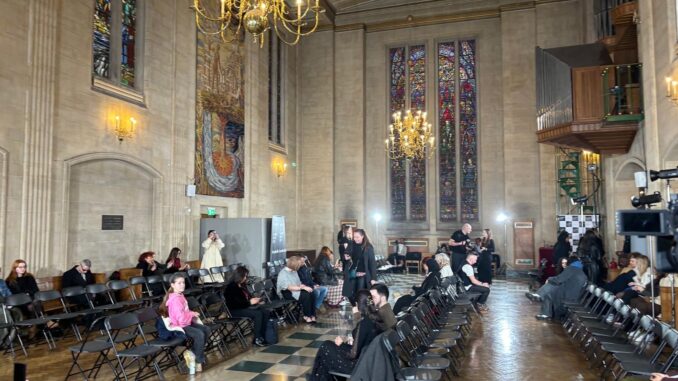
Fashion Week season can be exciting but it can also be anxiety-inducing
By Aliyah Difia Rahma
London Fashion Week just ended yesterday. The capital is known for it young up-coming talents, and the biggest fashion event of the year is an opportunity to discover fresh new faces in the fashion industry.
In the past, London Fashion Week served as the debut stage for designers like John Galliano, Simone Rocha, Alexander McQueen and Christopher Kane – who all became big names in the fashion industry.
Just this year, Pauline Dujancourt, who won Elle UK’s Generation Next Prize, receiving a financial bursary and expert mentorship, showed her first catwalk show at London Fashion Week dedicated to her late grandmother.
Aside from the glam and spotlight, Fashion Week harbours some of the most anxiety-inducing moments in fashion. From the pressure of the industry to keep working and meeting deadlines to the countless content that is pushed out during Fashion Week, it can lead to an anxious experience.
London is a great city for fashion students to learn about fashion because London is a city that really honours their young talents. For example, a lot of designers in London Fashion Week are fresh and young fashion graduates, but the city gives them a spot to display their talent for the world to see.

London is home to some of the greatest fashion schools in the world, which makes it a marquee destination for students to study fashion. Credit: Pixabay
Still, these students are encouraged to learn and know every nook and cranny of the fashion industry and be on top of the news cycle, especially during the Fashion Week month where it’s just non-stop content and news.
Alexander Calvin Pristiwanto, a fashion design student from Ravensbourne University in London, said that students are encouraged to see the news coming up from London Fashion Week.
“It does get intense around Fashion Week, it takes a lot of time to look at them one-by-one…and it’s just so much,” said Pristiwanto.
“It does get a bit stressful at times but as a fashion design student we do have to take a look at it,” he continued.
“You have to do it to find inspiration, to know what’s up, to know the new trends and style, so that we can be at the top of our game and find our own style.”
Trend generator
Fashion Week is the biggest trend generator and it could also get tiring to always be on the par with what’s trendy.
“It pressures me that my designs also have to stay on top of trends, it has to be up to par or it has to be good,” said Pristiwanto. He added that it made him question his designing ability, whether he is creating good enough clothes for the fashion industry.
What’s even more maddening is the fact that the fast nature of the industry is allowing fast-fashion companies to replicate their designs for a fraction of what the original cost. The hard work that goes into this could just be another copy and paste project by these companies.
Neelam Mistry-Thaker, a personal stylist and London-based creative consultant, said: “When things become mass-produced, they lose their individuality.”
Mistry-Thaker, who had been working with people to understand their bodies and build confidence from within, feels like there are expectations to fit certain criteria of an aesthetic and trends.
“We automatically assume that because they’re wearing it, it’s going to look the same on us…what ends up happening is it takes away the uniqueness of your personal style,
“I think what the shame is then whatever work goes into designing this concept, you lose that as well,” she said.
Independent designer Ayomide Adeyemo, from the brand 54folks echoes this sentiment as it was tough to design and innovate the way fashion expects designers to do.
“I’m actually open to create new things, but as an emerging designer it’s actually very tough to create…there are some challenges that can’t be ignored, we have to play safe sometime,” Ayomide said backstage after showing her first collection after graduating university last year at Fashion Show Live.
Ayomide after showing her collection at Fashion Show Live. Credit: Aliyah Difia Rahma.
She also noted how important it is to know what her market is to sell well and be well-received.
“You need to consider what they really want and what they need…sometimes you create stuff that you want, but it’s not what they need and what they want,” she said. “It’s about researching first before creating.”
Still, the constant designing and planning is the system in which the industry has thrived over the last few years and it hasn’t shown any signs of slowing down. It only seems to accelerate with time.
Giovanni Bordone, a lecturer from London Metropolitan University, has dedicated 15 years of his life to the fashion industry by working in companies like Zegna and Burberry. He believes that the industry is just wired that way because of profit maximisation.
“In fashion when someone gives you a deadline, when you have to do it is yesterday,” said Bordone, talking about how fast the industry moves.
“There is 100% sure there is pressure to see what everybody is doing, what works and what not works.”
All of this hard work culminates through a fashion show each season, despite the short amount of time when the fashion show happened, the preparation takes surprisingly long.
“You can plan it for months (fashion show), but two weeks before and 48 hours before is crazy,” Bordone said.

Backstage can be a chaotic place as models, makeup artists, hair stylist and many more try to make everything look perfect. Credit: Aliyah Difia Rahma.
“You have to try the collections and the models and find the right models for the clothes…they’re human being…so each needs to be served in a different way. One is not happy with their hair and the other the hem of the trousers dropped, so it’s incredible really.
“As soon as they (the models) turned the corner, a new outfit is going to be put on them. There are screaming, crying, laughter, smoking and running,” he said about how rewarding the end of a fashion show can be.
Creativity and hard work
These fashion shows, especially shown in Fashion Week, are the epitome of creativity and hard work where individuals pour their will into the show’s success. But, fashion breeds exclusivity and only a handful of people can experience the show firsthand.
It’s notoriously known that fashion shows to some of the most famous brands are invites only, which creates this barrier to being part of the fashion industry. This could make people who want in feel like they have to be someone to get in, making them feel left out.
Alexander Calvin Pristiwanto said that it can be frustrating for someone like him to find opportunities to volunteer at London Fashion Week.
Pristiwanto said “I really want to be part of Fashion Week, especially as an international student but I have no idea how to get into London Fashion Week.”

Getting an invitation to Fashion Week or a fashion show can be hard as you have to be a member of a press to be invited or someone in the industry. Credit: Aliyah Difia Rahma
Pristiwanto also felt like he needed to step up his game in order to find these opportunities as he believes it’s possible to get the opportunity he wants.
According to Priyal Verma, an MA Strategic Fashion Marketing from London College of Fashion said that finding an opportunity to participate in London Fashion Week is hard and does require a lot of time.
“If you want to work backstage for London Fashion Week, the way to go for everyone is just to cold email the brand, I started doing that in December,” Verma said.
Verma, who volunteered for a brand called Aadvenik, said that it was an enriching experience for her to work backstage for London Fashion Week. However, it’s still tricky to be part of the show as a student.
“It’s certainly hard work to get in London Fashion Week, especially if you don’t have enough contacts…but it’s not impossible to get in,” Verma added.
Even if there’s a chance to attend or volunteer at a Fashion Week show it could get discouraging to see the lack of representation in the room.
Neelam Mistry-Thaker, who was invited to London Fashion Week last year also felt this level of exclusivity affected how she views herself in the fashion space.
“I love fashion and I always wanted to go to Fashion Week and do all of these things there, but I didn’t see myself there,” she said.
She recalled the time when she could only see a few people of colour in the room with her, despite the changes it seems that there is still work needed to be done by fashion to make the space much more welcoming for people of colour.
“I would love to be within the buzz, but I also really think that the representation part is really difficult and seeing yourself in that space.”
What can we do?
Fashion Week or fashion can be a stressful and anxiety-inducing time for people who are involved in the fashion industry in some capacity. Waiting for the industry to slow down is not a viable option at the moment, but yet we can do some things.
Neelam Mistry-Thaker said that being in tune with brands or people who are on the same journey as you is a great help to feel like we’re not so alone in this journey.
“If you can find the magazine that talks to you, the influencers that speak your language, the aesthetic that you really love,” she said as a tip to make the journey less intimidating.
“Networking in London and just go to event and meet people who are in the similar journey as you,” she continued.
Fashion week or fashion in general can be a bit much for us, but it’s important to note that everyone starts from somewhere and this is an industry where creativity is what gets the gear moving. It might be tough out there in the fashion industry, but there are ways where we all can prevail.
Leave a Reply