
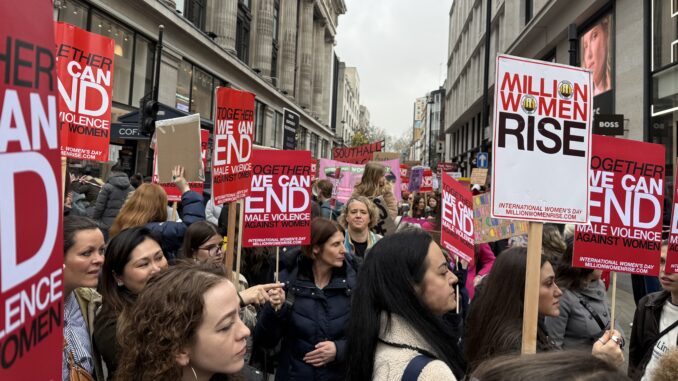
“We are not trying to stigmatise boys, it’s not their fault,” she said. “Kids are not born sexist. These attitudes are fed into them through the way they are socialised.”
By Niamh Hatfield
It’s a story that’s eerily familiar: more than one in four women are estimated to experience sexual assault or attempted sexual assault in their lifetime, while around one in 12 are affected by violence against women and girls each year.
The National Police Chiefs’ Council reported that in 2022–23, 20% of all police-recorded crime in England and Wales was related to violence against women and girls, and here in Islington, domestic abuse reports have risen by 18 per cent between February 2025 and February 2026, according to Metropolitan Police data, highlighting the scale of the issue at a borough level.

The figures point to a persistent issue, but also raise a key question: how can gender-based violence be prevented?
Across schools, charities and creative projects, attention is turning to how young people are learning about gender, relationships and respect, and what role education plays in shaping misogynistic attitudes long before adulthood.
It’s hoped that tackling misogyny in schools with a whole-school approach that involves mainly boys but also engages teachers and other stakeholders, could halve the rate of violent crime in the next decade.
Education and early influence
Sarah Mitchell, who volunteers with End Sexism in Schools, highlights how education shapes attitudes towards women and girls, with a specific focus on analysing the Key Stage 3 English Literature curriculum.
“Children are largely studying texts authored by men, but also written about the lives of men,” she said.
Research conducted by the organisation found that only two per cent of students were studying texts written by women. Mitchell argued that female characters are often marginalised or reduced to stereotypes within widely taught novels.
Using John Steinbeck’s Of Mice and Men as an example, she pointed out that the novel’s only female character is unnamed – and ultimately punished for her sexuality.
Mitchell discussed that education shapes wider expectations beyond literature, creating what she described as a “false impression” of leadership and achievement as male-dominated. She also emphasised the importance of representation in literature for developing empathy among children.
While she acknowledged that reforming the curriculum is timely and costly, she argued that education remains one of the most important tools in preventing violence against women and girls.
“If you have a patriarchal system, you are going to get violence against women and girls because women and girls are going to be seen as less or other,” she said.
However, Mitchell stressed that boys themselves should not be blamed.
“We are not trying to stigmatise boys, it’s not their fault,” she said. “Kids are not born sexist. These attitudes are fed into them through the way they are socialised.”
This tension around how boys are socialised into attitudes on gender and violence is also reflected in recent cultural narratives such as the Bafta-winning Netflix series Adolescence, which explores how teenage masculinity, peer pressure and online influence shape behaviour long before adulthood.
Hannah Walters, an executive producer of Adolescence said she had received “lots of messages of gratitude” from parents prompted to have open conversations with their children about the issues it raises.
She told the BBC that the drama has sparked wider debate around male rage and the influence of misogynistic online influencers, saying it aims to “give everybody a little shake” and ensure “this generation don’t get lost”.
This response highlights the impact that guidance, visibility and positive role models can have in shaping how young people understand and reflect on gender and behaviour.
Workshop Intervention
That idea of socialisation is something organisations working directly with young people are also trying to address outside of the classroom.
While curriculum reform aims to challenge attitudes on a wider scale, organisations like White Ribbon Northern Ireland focus on direct conversations with young people in everyday settings.
Gillian Lennon, a youth workshop facilitator for White Ribbon Northern Ireland, delivers sessions in schools, youth groups and sports clubs, as well as workshops for adults, creating spaces where young people can openly discuss relationships, respect and violence against women and girls.
Lennon said much of the work involves encouraging young people to reflect on beliefs they may never have previously questioned.
During workshops, she challenges students’ views by asking simple questions such as, “Why do you think that?” She said many respond by admitting they had never properly considered where their opinions came from.
“If they’re not given the information and support or the respect to make those changes, then they’re not going to,” she said.
Lennon argued that harmful attitudes are often shaped by personal experiences, social environments and online influence, rather than developing in isolation.
She added how some young people may have witnessed unhealthy behaviour at home or among peers, while others are influenced by persuasive online figures and social media content.
“There’s a lot of vulnerable people that can be sucked into these opinions,” she said.
She described how informal one-to-one conversations during workshops can often become the most impactful moments, allowing young people to express opinions they may never have previously voiced aloud.
“You see a lightbulb moment going off sometimes,” she said.
Lennon acknowledged that the work can feel slow and emotionally draining, particularly amid growing frustration around misogyny and violence against women and girls. However, she said the response from young people continues to give her optimism.
“You can feel like you’re banging your head off a brick wall sometimes,” she said. “I can’t say everything’s sunshine and roses, but what we are doing is so positive. The kids are so receptive.”
Despite these interventions, many young people still feel they were never properly educated about violence against women and girls during school.
Hugo Jamison, 23, a master’s student in Economic History at the London School of Economics and Political Science, said he did not receive enough education in school about violence against women and girls, either in the classroom or the wider school environment.
Jamison’s experience highlights a clear gap in formal education on violence against women and girls. Without structured learning, young people are left to form views elsewhere, underlining the need for more consistent education in this area.
Conversations beyond the classroom
As organisations look for new ways to engage young people, some are turning to creative approaches such as theatre.
Called Out, written by Cahal Clarke and directed by Aoibh Clarke, is a one-man theatre production exploring toxic masculinity and peer culture.
The show has been performed to almost 2,000 young people as part of the Ending Violence Against Women and Girls campaign.
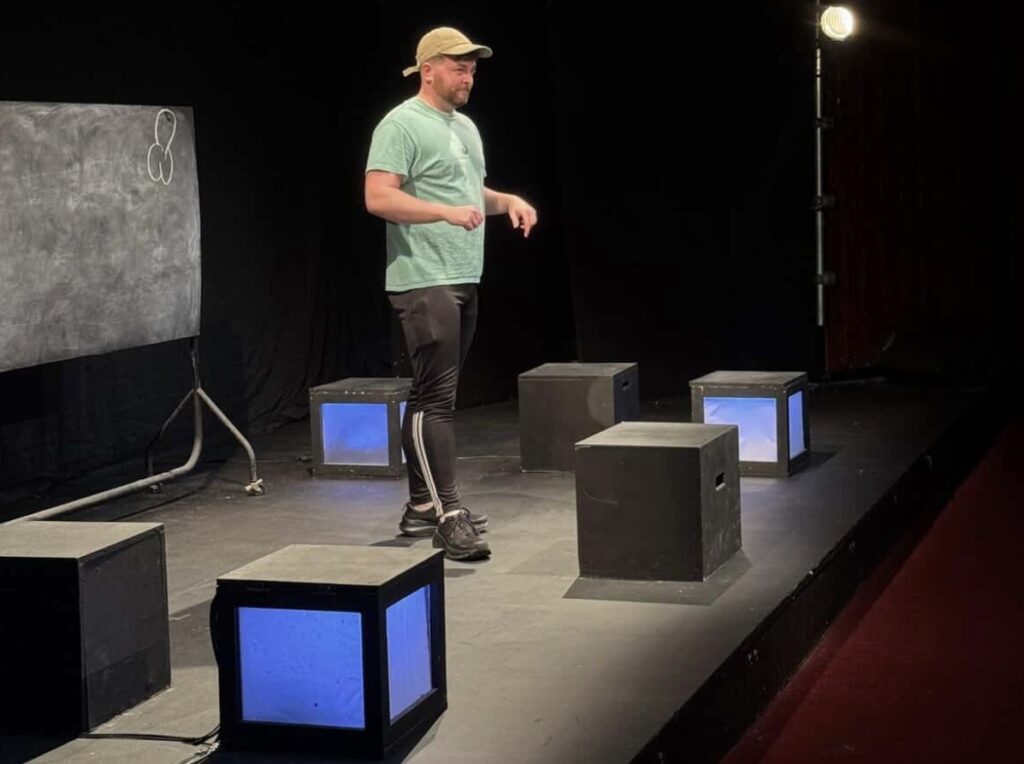
Aoibh Clarke said the production was shaped by the need to challenge attitudes from within.
“We need to speak to young men, we need to make change from inside,” she said.
Research with young audiences showed many boys instinctively distanced themselves from the issue, often saying, “Well I don’t do that.”
As a result, the team centred the play on what Clarke calls ‘the good boy’, a character who does not see himself reflected in harmful behaviour.
Clarke said the intention was for audiences to recognise parts of themselves in the character, rather than dismissing it as irrelevant.
“It’s about you who’s thinking it’s not about you,” she said.
A key theme throughout the play is complicity and the role of bystanders.
Ronan Evan Johnson said the production challenges audiences who remain silent when witnessing harmful behaviour. “We want to show that you’re just as complicit if you don’t say anything and you don’t do anything when you see it,” he said.
Clarke added that the aim is not to shame audiences, but to encourage reflection. “We probably want a healthy amount of shame, just a little bit where you’re going, ‘Am I complicit in this?’”
Impact on young people
The team behind Called Out said feedback from schools has been overwhelming. Of nearly 2,000 young people who have attended performances, around 1,100 submitted feedback forms.
Teachers have also reported safeguarding impacts, with some students disclosing personal experiences after seeing the production.
Feedback from students included comments such as:
“I’m realising that they’re not just a sister or a mother or a cousin, they’re someone.”
“Just because I didn’t start the fire doesn’t mean that I can watch the house burn to the ground.”
If prevention is the goal, the question is no longer whether education has a role to play, but whether it is currently doing enough to meet the scale of the problem.
These examples show both the positive and negative influence education can have on young people in preventing violence against women and girls.
From what is taught in classrooms to the messages absorbed outside them, young people are constantly learning what behaviour is normalised.
*Some names in this feature have been changed for safety reasons.
Leave a Reply