

By Maria Caires
Image by Evgeni Tcherkasski from Pixabay
With the hotter months upon us, it is important that your city has the right amount of green spaces for its citizens to wind down and take a breather.
Green spaces significantly help reduce urban heat, by lowering surrounding air temperatures by up to 11 degrees Celsius, in some cases parks and trees provide plenty of shade and evaporating water which in turn would cool the surrounding air.
What’s the Urban Island Heat Effect ?
The urban heat island effect is a phenomenon where some cities might experience significantly higher temperatures often 1-7 degrees higher during the day and 2-5 degrees higher at night, than other surrounding rural areas due to human activity.
Most built up cities have concrete and asphalt; these materials have low albedo (reflectivity) and high heat capacity which absorbs and re-emitting solar energy; and buildings that absorb and store high concentrations of heat, then releasing it at night which this then can raise the city temperature by as much as 12C in the evening.
Because of this London homes are greatly overheating due to this effect, this is also because of a densely built environment and an outdated planning and design system.
With the increasing temperatures over the past few summers, extreme heat has become an alarming issue in London, “with more than a 10th of the 3,271 UK-wide heat-related deaths in 2022 in the capital”, according to City Hall.
The BBC reports that “City Hall is currently drafting London’s Heat Risk Delivery Plan, which could include “cool spaces” around the city, thousands of water refill points and plans to plant thousands of more trees”.
Heatwaves during the summer
It is no surprise that the past few summers the temperatures have been increasing rapidly with many struggling even to stay indoors. People around Islington have said that to make themselves comfortable with the rising temperatures they resort to “ very light clothing, natural fibres, I’m lucky my office is air conditioned,” says Helen.
Video by Maria Caires
Why so many heatwaves ?
The House of Commons says that “heatwaves in England have become more frequent and intense primarily due to human-induced climate change, which has more than doubled the likelihood of extreme heat in the UK.”
This is also caused by something called ‘Jet Stream and atmospheric blocking’. This is when jet streams that bring weather systems, often moves north of the UK during the summer, so this allows for high-pressure systems to stall over the country, resulting in a prolonged dry, sunny and hot conditions.
With England having less rainfall during the summer, the ground will actually remain dry, the sun’s energy then goes into heating the air rather than the moisture evaporating, resulting in creating more intense local heatwaves.
The House of Commons says that “research indicates that summer heatwaves that were rare in the past are now becoming regular events, with 2022 seeing a new record-high temperature of 40.3°C.“
But not everyone is that opposed to the sun. Hannah says “ I love it, except the insulation in the house, cause obviously it gets really hot in there and there’s no way of getting out, you leave the windows open and the heat comes in.”
Hannah also says “when you go on holiday and you get that kind of weather, you dress for the occasion, you can’t exactly dress for the occasion in the UK, because you still have to go to work, …, so I guess that’s the only downside of things, but I do love a bit of warm weather.”
Videos by Maria Caires
Green spaces in Islington
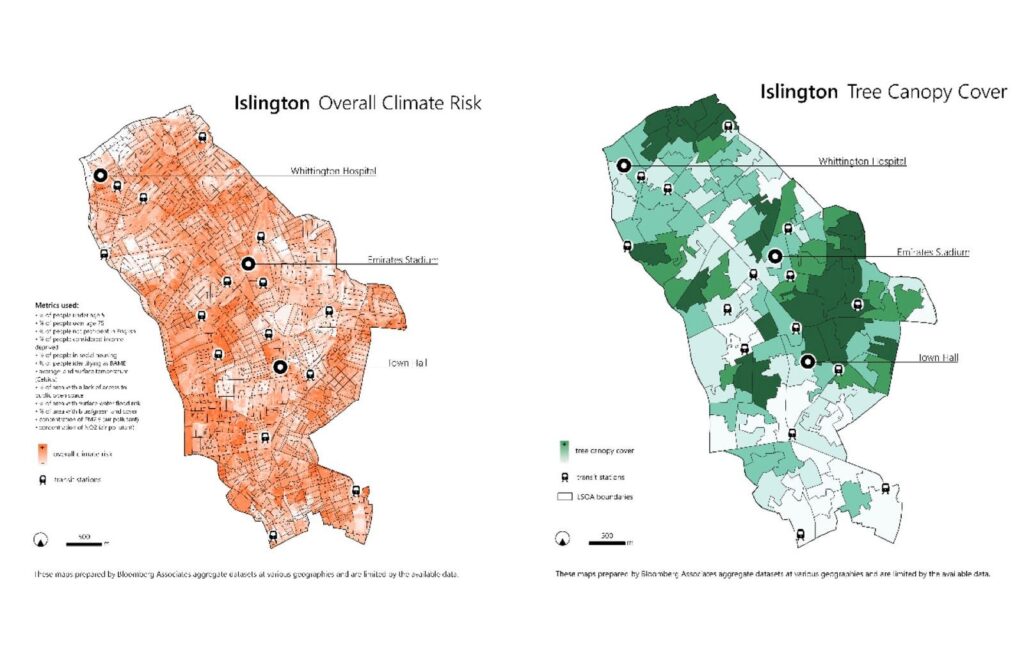
Islington Giving says that the borough is “considered very low on green space, having one of the lowest amount of green space per person of any local authority in the UK . “ They continue by saying “only about 6.3% to 13% of the borough is green space, significantly lower than the 17% average for London Boroughs.
Business manager of Hanover Primary School on Noel Road, Islington, Maria Savage, says that the school has sent multiple applications to request funding from the Greater London Authority. The scheme ‘Grow Back Garden’ aims to create various projects to implement green spaces for primary school children.
The focus of this scheme is to target areas of London with high climate risks and low access to nature, funding projects like new community gardens, tree planting and green roofs.
This scheme has helped to create almost 4 hectares of new green space and 13 hectares of improved green space.
The project ran from 2023, funding community gardens which have helped bring down temperatures and help the climate.
However, Islington Council is ready to face these challenges and actively work to increase green areas, including creating pocket parks, and also increasing their tree canopy cover as part of their Greener Together Initiative.
The Council reinforces this by saying “We are determined to ensure that by 2030, people in Islington can live healthy and independent lives and enjoy London’s greenest, cleanest and healthiest neighbourhoods.”
Is there going to be another heatwave this summer?
The Independent says that “Britain could be set for a welcome change in weather, with temperatures potentially soaring into the mid-20s just in time for the late May bank holiday weekend.”
The Independent also reports from The Met Office saying “widely below average, with a brisk north-westerly wind making it feel even cooler for many,” with some areas experiencing single-digit figures.” They continue by saying “however, early predictions indicate a significant shift by May 25th.”
Based on the forecasts of the Met Office, temperatures are expected to rise and become warmer as of mid-May 2026. The Met Office says, “while early summer 2026 is seeing warmer trends, the Met Office has not officially confirmed a severe, nationwide heatwave for the immediate fortnight.”
People around Islington can take a break from the blistering temperatures and enjoy the nice regulated ones, although the proper measures, like sunscreen and drinking plenty of water to stay safe from the sun are still widely advised.
Leave a Reply