
By Amalie Meland
Pollution in London is mostly caused by road traffic, and in the last 10 years there has been a 70% increase in motor traffic on local roads, according to Camden Cyclists. To reduce this, one of the elements of the Mayor of London’s Transport Strategy is to get more people to hop on their bike.
The biggest cause of air pollution in London is road vehicles. They produce around half of the nitrogen oxides, and they emit particulate matter, which contains microscopic solids or liquid droplets that are so small they can’t be seen – but cause serious health problems.
According to TFL , the latest evidence shows that air pollution increases the risk of life-changing illnesses such as cancer, asthma and lung disease as well as dementia in older people, and it contributes to the premature death of thousands of Londoners every year.
London Cycling Campaign is a campaigning organization that works to make cycling in London safe and enjoyable for everyone. Their work is led by a network of volunteers across the city in local groups in every borough.

John Hartley, 75, has been cycling for many years and has been a part of the London Cycle Campaign for around 35 years, first in Camden but now as a secretary in the Islington branch, Cycle Islington, for the last five years.
He says they rely very much on local campaigners who know their local area to do campaigning. “We campaign for better cycling infrastructure, safety improvements, little things that make cycling a little bit easier. The principle is to make cycling available to or possible for people 8-80.”
There are many benefits to cycling, he says. “It’s a very efficient way to get around, it’s cheap, it’s non-polluting. We are in the middle of a climate emergency, there are so many reasons why people should use bicycles rather than private motor vehicles.”
Bikes don’t release emissions that pollute or carbon dioxide that contributes to climate change like cars do. According to research carried out by the University of California at Los Angeles, a moderate increase in bicycle use each year could save an estimated 6 to 14 million tons of CO2.

During the pandemic the number of road vehicles went down, but a car-based recovery would lock London into dirty air, gridlocked roads and the deadly effects of climate chaos, according to Cycling London’s “Climate Safe Streets” campaign.
Infographic by Amalie Meland
“All the evidence on climate is increasingly clear that the next few years of action will be crucial. We can, and must, ensure we’re building the better future Londoners deserve instead of a car-led dystopia,” it said.

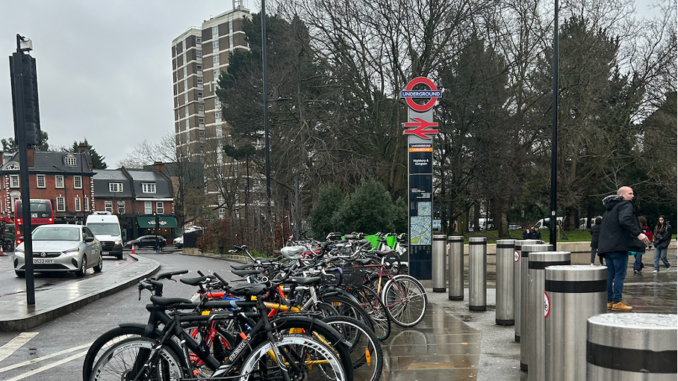
Photo by Amalie Meland
According to Hartley, one of the reasons people don’t want to cycle is their fear of being injured by collisions with cars.
“There are those who would love to cycle but are just too frightened because they hear horror stories about people getting knocked off their bikes. Those are the ones for whom cycling infrastructure is so important.”
During the pandemic, London Mayor Sadiq Khan initiated the Streetspace programme. In the first months of the program, Transport for London and London boroughs built segregated cycle lanes and footpath widening, and provided funding for local London councils to follow suit to avoid a ‘car-based recovery’. But after the pandemic, the work speed has slowed down.
Hartley says the busiest roads should have their own bike lanes: “Busy roads should have full segregation everywhere, so people on bicycles can go along and around safely, knowing that they are going home that evening.”
It is not only safer to have segregated cycle lanes, but it is also less harmful to cyclists, as it is shown that using segregated bike lanes reduces exposure to dirty air. Moving a metre or two from traffic cuts exposure to particles by about a quarter, according to a 2018 study in Leeds.
Leave a Reply