
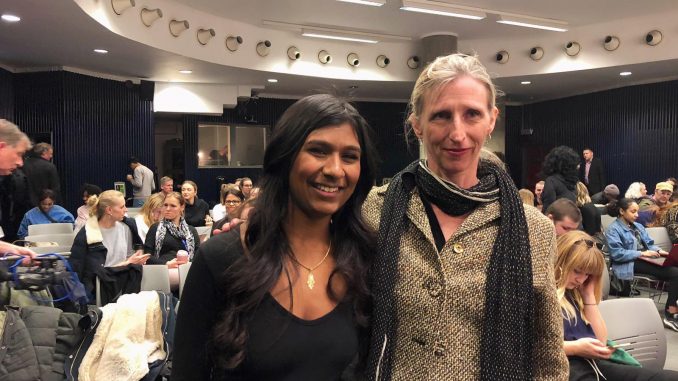
Pictures by Richie Hancox, Filippo Seccanibbi and Reza Sardrood
‘The failure of Mrs May to get to grips…is shameful’

By Reza Sardrood
Adam Jogee’s parents and grandparents were Labour supporters, so it’s no surprise he became a Labour councilor for Hornsey, Haringey in 2014.
The 27-year-old has always been passionate about politics, and always been willing to get involved in the Labour party’s activities. He first campaigned in 2005 in the general election in Horsney, Wood Green.
He later worked as a parliamentary researcher for Diane Abbott, the current shadow Home Secretary, whom he calls the “best boss I ever had”.
Abbott was the “boss who would always fight your corner. She is a history maker. She is somebody who every day gets up and shows what it means to care about something, what it means to fight for a better world,” he said.
Nelson Mandela is his other inspiration, along with his family. His father is half Indian and half Zimbabwean and his mother’s father is Jamaican, and he has been inspired by their “journeys to this country”.
He told the Brexit panel that he believes Brexit is distracting the country from national and domestic issues, such as austerity and knife crime. He used as an example Theresa May’s claim that there is no direct correlation between certain crimes and police numbers.
Mrs May’s statement “shows just how out of touch she is,” he told the panel, adding: “The failure of Mrs May to get to grips with it is shameful.
“I would not say that as a Labour politician but as a citizen and a taxpayer.”
Given the uncertainty about Brexit, Jogee sees that “cherishing the values of solidarity and togetherness and integration and diversity in Haringey and more widely in London and Islington”, is a priority.
‘Even as a kid I was a weird slightly freaky news person fascinated with radio.’

By Bernardo Almeida
Paul Osbourne is an accomplished journalist and broadcaster for BBC Radio, where he takes calls from the public and discusses their concerns, whatever they may be.
He also juggles his days between a discussion programme and news reading at Monocle 24 where he talks about UK politics with a focus on Brexit.
“Even as a kid I was a weird slightly freaky news person fascinated with radio,” he told the Brexit Bulletin. “That is not normal.” More than 25 years on, he’s closely followed changes with the advent of social media and citizen journalism.
“It’s the immediacy,” he says. “One of the things we used to say in radio was the great advantage we had over newspapers and television was that they were once a day and maybe twice in the evening and we were every hour. Obviously we aren’t anymore.”
He started a podcast called “Party Games” in 2015 where he keeps up with the latest issues and with some humour, delves inside Westminster.
Speaking on his view of Brexit he said: “The terrible awful truth is when someone in 20 years writes a book, the referendum was promised by a man who thought it would never happen. If you wrote that for a movie it wouldn’t pass development.”
In 2012 he received a Silver at the Sony Radio Academy for Best News and Current Affairs Programme, while he was a news editor at ITN.
He is a graduate from Lancashire University class of 96.
‘We have to fight for legitimacy in this environment’
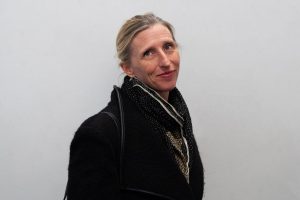
By Gennaro Costanzo
Ellen Barry is the Chief International Correspondent for The New York Times based in London. She has had an extraordinary career working as the Bureau Chief for both the Moscow and South Asia editions of the newspaper covering social issues such as immigration, demographics and culture across Europe.
In 2017, her in-depth articles on women’s role in India’s workforce got her the Asia Society’s Osborn Elliott Prize for Excellence in Journalism in Asia. Barry has previously won the 2011 Pulitzer Prize for international reporting for a series on impunity in Russia’s justice system.
‘The truth is that you can see much more with your own eyes than you could even imagine”, she says, “and one is being able to witness – particularly for a foreign correspondent – the important processes that are transforming our society.”
When discussing about the main differences between the American and the European journalistic styles, Barry says: “There is a little bit more transparency on the US government side, in the sense that there is a strong culture of anonymous briefings here (in the UK) and in the US you just wouldn’t find that.” She also says that the libel law represents a huge difference which allows American newspapers to be a lot more aggressive when reporting allegations.
Barry says that activities in Parliament have led to similarities between Brexit and Trump’s election. ‘These are two kind of twin democracies. We’re definitely on a period of extreme flux. I was really struck that our government was in shutdown while yours (UK) was in gridlock.”
Asa Bennett – Tales of The Telegraph

By Kirsty Gregory
Journalists working in political circles have a responsibility to ensure they maintain an objective stance in their writing, the Telegraph’s Brexit commission editor, Asa Bennett, told the Brexit Bulletin before Tuesday’s debate.
“First of all, you have to make clear in your own mind whether it’s news or an opinion piece you’re writing. If it’s an opinion piece, you’re supplying an argument,” Bennet said.
“If it’s news what we’re increasingly finding, is that if you’re not objective or looking at the facts of Brexit seriously enough, your news is going to fall apart and you’ll be a joke, because you’ll be proved wrong.
“If you start to use opinion words such as ‘this is a valid argument’ in a news piece, that’s when you start to blur the line.”
English journalist Bennett, who also writes the Telegraph’s daily Brexit bulletin, has worked for the paper for just over four years and does a range of jobs for the publication, including commissioning and editing comment pieces.
His work has been featured in a range of publications, such as the BBC, Yahoo, HuffPost UK, the Irish Independent and News International.
Bennett regularly posts videos to The Telegraph website where he analyses things going on day to day, including the Prime Minister’s Question Time.
Bennett said during the debate that he believed that “people are going to feel the impact of a no deal Brexit” after voting to leave in the 2016 EU referendum.
The journalist also said that it would not be democratic for the UK to hold a second referendum, as it would mean that those that voted leave originally would feel betrayed by the UK Government.
‘Your audience is only as stupid as you treat them.’

By Monéh Vidal
With left-wing political views, Ash Sarkar works hard to raise awareness about social issues of race, gender and class. The 26-year-old journalist is a senior editor at Novara Media and also teaches a political theory at Anglia Ruskin University and the Sandberg Instituut in Amsterdam.
“My racial identity is front and centre, I can’t pretend to not have one,” she told the panel at yesterday’s Brexit debate. “What I have to ask myself is why can’t I navigate life in the same way my friends who are white, from better off backgrounds and who are male can?”
The fact she has been treated differently – and therefore feels different – has nothing to do with her, she told the panel. It’s a result of how society creates positions based on class, race and gender.
We need to work out whether these issues are “a product of a natural hierarchy or are these historically and socially constructed? Because if they are they can be deconstructed,” she said.
Sarkar expressed concern over Britain’s impending exit from the EU, saying it would have a particular effect on minority groups. She said she fears that when we don’t get everything we were told we would, it will cause an “everyday hostility”.
Within Novara Media, Sarkar covers controversial issues such as Neo-fascism, Trump and Black Lives Matter. Having challenging material on the website allows readers to explore deeper issues because “your audience is only as stupid as you treat them”.
Leave a Reply