

By Mali Sapsed Foster
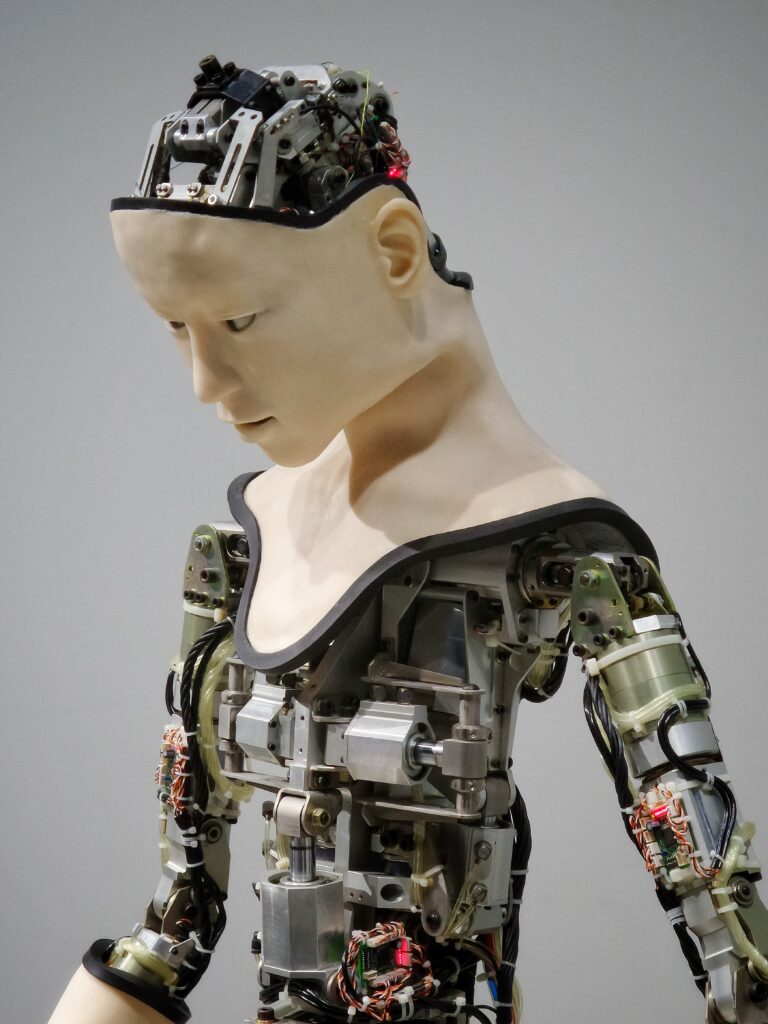
Photo by Possessed Photography on Unsplash
Technologically advanced as the world is today, it may be hard to remember life when the concept of artificial intelligence was simply limited to science fiction movies, dystopian novels, or the ramblings of conspiracy theorists. Today, it is everywhere – and you have most probably used some form of AI today.
Unbeknownst or not, the probability of using a form of AI by the time you started reading this article is extraordinarily high. Did you use Google or Apple Maps to arrive where you needed to be today? You have used AI. Unlocked your mobile phone with face ID? You have used AI. Spoken to Alexa or Siri? You guessed it – AI.
Artificial intelligence is so ubiquitous that there are immeasurable examples of ways the average person will interact with it in their day-to-day lives. AI has benefitted society and is ultimately changing the world – and it can tell you so itself.
As seen in the video above, it only took 49 seconds for ChatGPT, a chatbot processing tool driven by AI technology, to produce an academic, clear assertion of how AI has changed the world. The artificial intelligence tool has become a sensation, with the ability to explain quantum physics, write high-level academic essays in mere minutes, or even have a conversation – due to its ability to form human-like responses and stimulating questions.
The ground-breaking tool, created by OpenAI – a non-profit startup funded by several renowned tech executors and investors such as Peter Theil, the co-founder of PayPal, and Reid Hoffman – founder of the LinkedIn network, has caused phenomena that have led to many conversations about the benefits and negatives of Artificial Intelligence.
The conversation around the negatives, however, has been exacerbated by comments made by OpenAI’s debatably most infamous co-founder, Elon Musk, – who tweeted: “ChatGPT is scary good. We are not far from dangerously strong AI” in 2022.
How did we get here?
The idea of Artificial Intelligence – a domain within computer science that has been created with the ability to replicate human intelligence and problem-solving capabilities – is often associated with a new futuristic concept. Surprisingly, however, the birth of AI goes back just over 70 years ago, to 1950.
While Alan Turing notably published his 1950 work ‘Computer Machinery and Intelligence’ of which experts used to measure computer intelligence, the first artificial intelligence system, Theseus, was built that same year by Claude Shannon: a remote controlled mouse that had the ability to exit a labyrinth and remember its route.
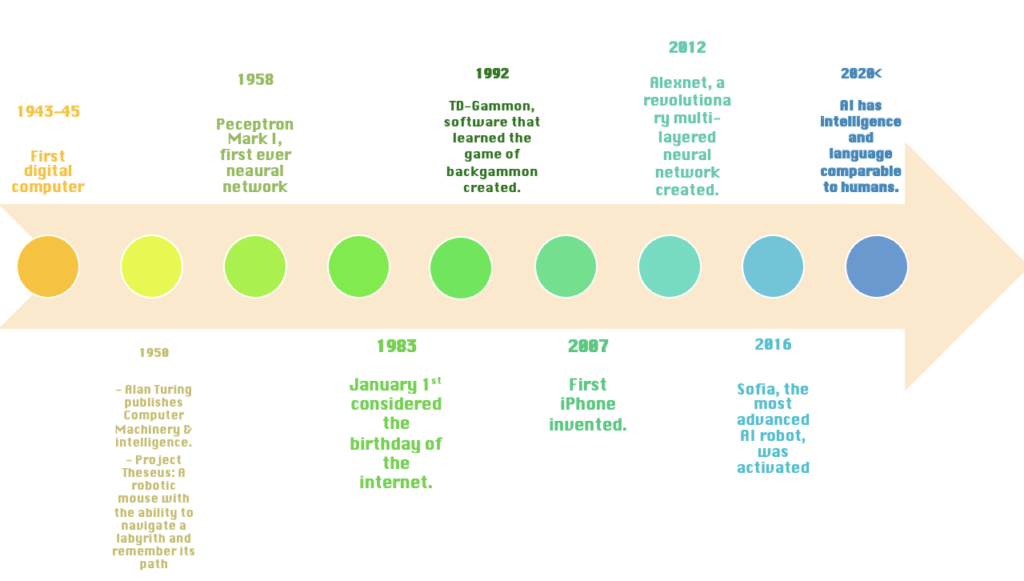
As seen in the timeline of artificial intelligence system creations above, there have been rapid advances in the performance abilities of AI systems – from Theseus to Perceptron Mark 1’s launch in 1958, the first-ever neural network, to the astoundingly progressive system named TD-Gammon released in 1992 – software that learned the game of backgammon and rivalled the top human players.
The next notable artificial intelligence development was Alexnet in 2012 a revolutionary system composed of a multilayer neural network with the ability to recognise images at an almost human level.
Alexnet paved the way for the creation of artificial intelligence systems in the late 2010s and now, that recognise language, and images at a level comparable to humans.
Artificial Intelligence has continued to develop at an extraordinarily rapid pace, and there is no going back. Each system is more advanced than the last, and we are still ultimately in the early stages of its conception. It cannot be removed or undone – AI will be here forevermore.
The dark side of AI
Whilst artificial intelligence has undoubtedly revolutionised efficiency within society: from businesses to research methods, to simply easing the trials of everyday life – science fiction movies were not wrong to portray AI as a potentially global threat.
In conversation with the BBC, Professor Steven Hawking – Nobel prize winner and one of Britain’s most distinguished theoretical scientists, warned of the dangers of AI: “The development of full artificial intelligence could spell the end of the human race…it would take off on its own, and re-design itself at an ever-increasing rate. Humans, who are limited by slow biological evolution, couldn’t compete, and would be suspended.”
The legendary scientist, diagnosed with amyotrophic lateral sclerosis (ALS), raised his concerns following a question from a BBC correspondent about the development of the technology he used to communicate, using basic AI.
Today, artificial intelligence has matched and even surpassed human capabilities in some areas, but the one thing the computerised systems lack is human emotion.
Elon Musk, billionaire entrepreneur and co-founder of OpenAI echoed these sentiments in the documentary ‘Do You Trust This Computer?’ stating: “AI doesn’t have to be evil to destroy humanity – if AI has a goal and humanity just happens to come in the way, it will destroy humanity as a matter of course without even thinking about it, no hard feelings.”
What does this mean for us?
Besides the apocalyptic potential of artificial intelligence, there are fears that, with its potential to match human capabilities and exceed our level of efficiency, AI will eventually replace humans, starting in the workplace – and they already have.
Goldman Sachs, a leading global investment banking, investment and securities management firm, predicted that 300 million jobs will be replaced by artificial intelligence in a March 2023 report, and many have voiced their concerns over social media.
“I don’t want to live in an AI world,” said Chloe Hanson, a 24-year-old resident of Muswell Hill, who shared her resentment for large corporations replacing their human workers with artificial intelligence, “It’s an idea rooted in capitalism that will eventually make the whole world self-destruct.”

Chloe Hanson, who requested her identity to be concealed, before her interview. Image by Mali Sapsed Foster
Hanson, who is currently studying for her BSc in Environmental Science, also shared her perspective on AI saying: “It will have repercussions, starting with people’s jobs…I don’t know how far it will go but it won’t go anywhere good.”
But AI is already replacing jobs faster than we think.
This is a scary reality for India Canaan, a 25-year-old editing assistant at a scientific magazine, whose work has already begun to replace high-level employee roles with artificial intelligence.
“A team of production editors in the US was made redundant,” she revealed in an interview. “Now AI is able to copy edit and will also be starting to write research highlights instead of a human editor. What will happen when it becomes so advanced that editors and authors will no longer be needed to write academic literature?”
While she worries about her job progression, she admitted to feeling safe in her role for the moment – but fears the bigger picture with AI becoming so dominant in society.
“I find it disconcerting and scary – it has a lot to do with the great filter theory. We are getting so advanced that we will start to create our own fall in human civilisation and die out.”
Leave a Reply