

by Weronika Maleszewska
Caroline Ash, Director, Fashion Enter/Fashion Capital, has 40 years’ experience in production management. So it’s no surprise that she was one of our five fashion-related guest speakers at the London Met Journalism Newsweek: Fashion Reborn: Reuse and Rethink.
She was one of five panellists who care not only about fashion being a safe, ethical place but also helped to spread their enormous knowledge about the important issues.
Caroline’s career has allowed her to see the worst, she told the packed room. “I have seen some terrible things my time, like children working on the adult conditions in China, and slave labour going on today in a big way as well, both in the UK and abroad.” There are all different kinds of exploitation, slave labour being the worst, but also you can have people working for the minimum wage in countries where that might be a pittance.
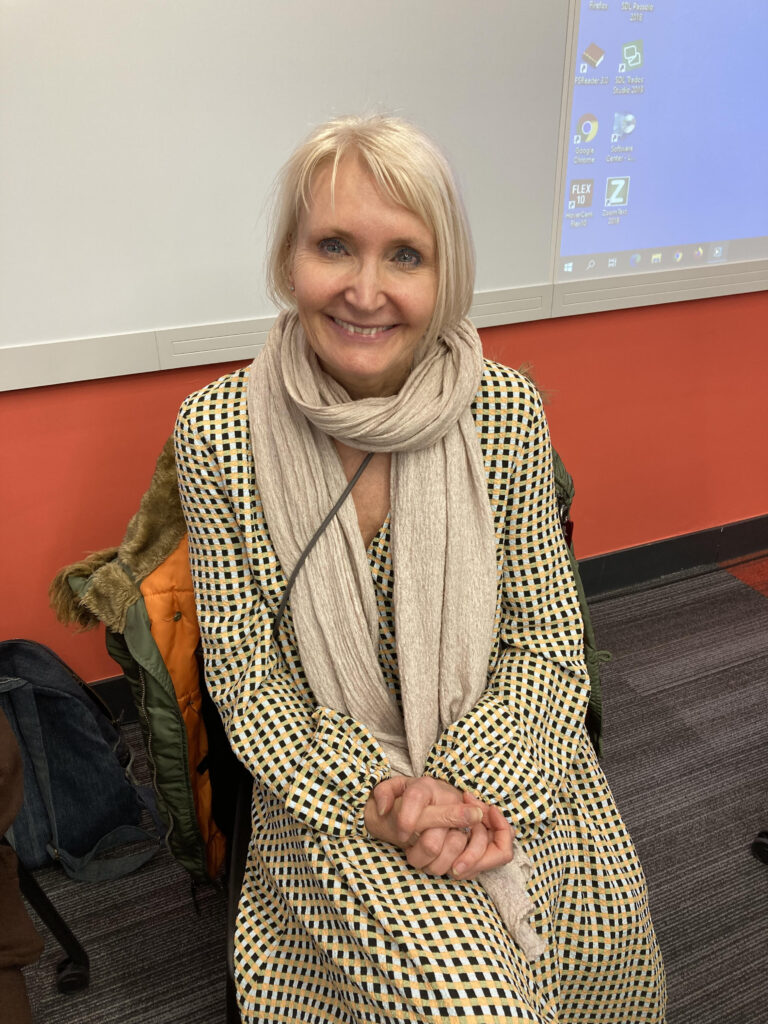
Caroline has been the Head of Production for various companies supplying the high street, making soft separates, dresses and tailoring. She has manufacturing experience in China, Morocco and Egypt, as well as the UK.
Being a highly experienced production coordinator, sourcer, and product developer, Caroline’s strong problem-solving and analytical skills helped her deliver products that meet lead times, quality expectations, and ethical requirements.
Tenacity is one of the core qualities needed in the fashion business, says Caroline: “There are always problems that need a quick solution.
“No two days seem to be the same – which is one of the things I love about my job. I might be meeting new clients; I might be teaching.”

Photo by Sam Sorabjee
Her skills didn’t come naturally, she says. All the highly critical ways of thinking, ability to analyse, and not being afraid to ask the important questions, came with time and a lot of practice. “The eagerness to learn and always dig deeper is a key. The fashion industry is full of undeveloped and extremely intriguing paths,” Caroline says.
Her ongoing journey with fashion includes ensuring fabrics and trims are delivered and approved in a timely manner, keeping to a schedule, and if there are delays seeing how to mitigate them to ensure customer deadlines are maintained.
“My work is also majorly about getting to know and assuring that everyone is happy and the working conditions are okay.”
For the question of how the UK has approached giving factory workers fair labour conditions, Caroline pointed out: “It’s not just the UK. It happens everywhere. China, Turkey, Malaysia. An audit is just a starting point…”
What is an audit?
“An audit is when someone would come to my factory, unexpected, they come unannounced. This obviously helps with the most real evaluation they can possibly make,” explains Caroline. They would have a look around the factory, checking if the basic required conditions in the working space are being observed.
Another interesting responsibility of theirs is to give cards to the workers. The cards are the tool for so-called whistleblowing. Each card has its own number, so to be anonymous, workers can complain or simply share their working experience, helping to build a reliable report.
“It really can make a huge difference and, what is even more important, prevent the further inconveniences and law violation within the working conditions,” she says.
Her overall knowledge in the production sector of fashion makes her an excellent mentor to students and industry professionals, just like London Met students.
“We are not doing anyone favours, we are doing what everyone should be doing. Everyone is a human. Everyone, no matter what position or profession is in, should be treated according to human rights.”
Leave a Reply