

Photo by Gennifer Miller Unsplash
Words and photos below by Liam Nicolson and Liedson Moreno Gomes
The bus is late. There is nowhere to go and nothing to do. So, almost instinctively, a hand reaches into a pocket. A phone appears.
Within seconds, a boring wait for the bus turns into doomscrolling Tiktok, or checking WhatsApp or browsing Spotify.
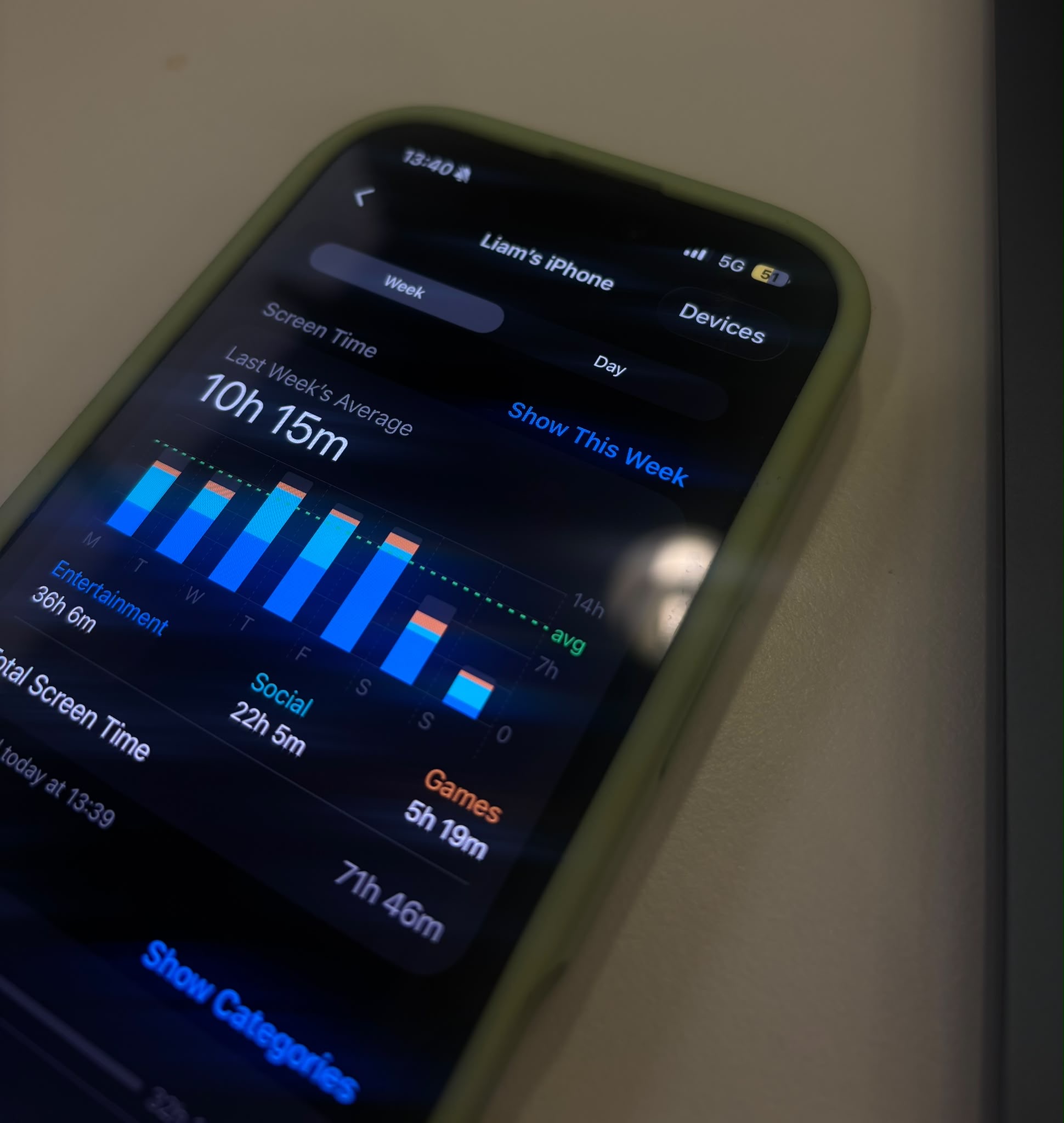
For young people who have grown up with smartphones, boredom can feel less like an ordinary part of life and much more like a problem that needs solving.
“I normally just end up on Tiktok because its the easiest way to be distracted and entertained,” said student Cheurlie Petek
But researchers are beginning to question whether constantly escaping boredom actually makes us less bored. A 2024 study published by the American Psychological Association found that people who repeatedly switched between various online platforms to fill time reported greater boredom and less satisfaction than the ones who either did nothing or stuck to a single platform.
Across seven experiments which involved more that 1,200 participants; the researchers found that constantly searching for more entertainment would actually make things seem far less engaging.
That suggests a strange possibility: the technology we use to escape boredom might sometimes be helping to create it.
Boredom itself isn’t necessarily useless. Psychologists describe it as an unpleasant state that can signal a lack of meaningful engagement, but it can also push people towards new activities and ideas. Research discussed by the American Psychological Association has linked boredom with creative thinking and experimentation.
For students, the issue may be less about spending hours on a phone and more about what happens during the gaps in between.
Waiting for a lecture. Sitting on the tube. Eating alone.
These used to be empty spaces. Now they can be filled instantly.

When was the last time you deliberately did nothing? “The only times I do that is when I’m at work, I just like to stare outside and wait for customers to come in because then I have something to actually do, I feel addicted to my phone and I hate having nothing to do,” said student Danielle Thomas.
For students, the question is whether constant access to digital entertainment is changing how they experience their downtime. With research suggesting that switching repeatedly between online videos can increase boredom rather than relieve it, the relationship between screen time and satisfaction is becoming increasingly important to understand.
As smartphones continue to shape how young people spend their free time, researchers’ findings raise a question that extends beyond screen time alone: are we using our devices to make our downtime more enjoyable, or making it harder to enjoy doing nothing at all?
Some says sitting still has its benefits. “When we shift into the relaxed state of non-productivity or niksen, our brain moves to a different state of activity, it recharges, our memory improves, and our creative brain has more space to shine. It’s also useful to alternate periods of high productivity with periods of rest. Grinding on working harder and harder can result in lowered productivity,” says The Talking Room.
“When we implement periods of doing nothing we feel less stressed and replenished, contributing to our overall well being.”
Leave a Reply