
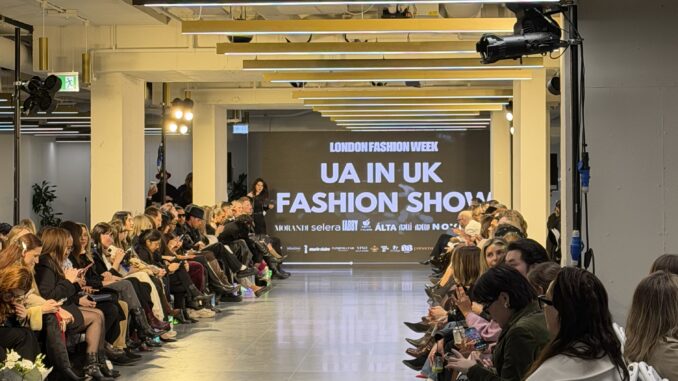
The runway UA in UK fashion show. Image by Anastasiia Savina
by Anastasiia Savina
A platform within the platform
During London Fashion Week this month, the UA in UK Fashion Show offered more than a runway presentation. Organised by modelling agent and Ukrainian entrepreneur Aleksandra Volkova, the platform positioned Ukrainian and emerging international designers inside one of the world’s most recognised fashion calendars not as outsiders, but as visible participants.
The show did not attempt to imitate established houses. Instead, it carved out its own space focused on cultural identity, collaboration and resilience.
For Volkova, representation is not symbolic; it is strategic.
“For me, it is pride,” she said. “Some people donate financially. I cannot always do that. But I believe sometimes money is just fish we need to give people a fishing rod.”
Through fashion, she explained, Ukrainian brands gain visibility and access to international audiences without framing themselves as victims of war.
“We are not saying ‘we are poor, help us.’ We say: despite the war, we work. We develop. We create.”


Backstage at the show. Images by Anastasiia Savina
Challenging perceptions of Ukrainian fashion
Volkova is direct about misconceptions surrounding Ukrainian design. Many international audiences, she notes, still associate Ukrainian fashion exclusively with traditional embroidery.
“In Ukraine there are very strong brands,” she said. “They are not worse than Italian or French ones. The difference is visibility.”
The platform therefore serves as both a creative and economic opportunity – helping designers present themselves globally and form new professional connections.
Behind the scenes: coordination and pressure
Executive producer Konstantin Komov highlighted the complexity of organising a show of this scale.
“I connect everyone volunteers, models, designers, partners,” he explained. “Before the show starts, everything must work.”
From technical checks to backstage timing, his role involves constant coordination. Yet he acknowledged that producing a fashion event while war continues creates emotional tension.
“It’s difficult to talk about balance between creativity and success,” he said. “Because while we are here, our country is still being bombed.”
Fashion, in this context, becomes both professional activity and a quiet act of continuity.
Designers and the idea of renewal

Marva Mokhammad, stylist and designer. Image by Anastasiia Savina
Among those involved was stylist and designer Marva Mokhammad, a 22-year-old Afghan woman from Ukraine. While she styled one of the runway segments, she also shared the concept behind her personal collection, centred on the idea of “new life”.
“My collection is about giving something used a new life,” she said, describing her use of reworked denim and second-hand materials. Sustainability, she noted, is not a trend but a necessity.
Her aesthetic blends modern modest silhouettes with cultural influences drawn from both Afghan and Ukrainian backgrounds, reflecting layered identity rather than a single narrative.
The model’s perspective
Model Arsenii Zhukov, 19, who walked for Alta.Men, described the backstage atmosphere as intense but focused.
“You listen. You stay organised. That gives you confidence,” he said when asked how he prepares before stepping onto the runway.
Addressing the influence of artificial intelligence in fashion, Zhukov was clear:
“AI is a tool. It cannot represent emotion.”
Collaboration over competition
Across interviews – from organiser to producer to designer to model – one theme remained consistent: the show is built on collaboration.
“I believe in win-win,” Volkova stated. “If you help, you receive. If you only take – it doesn’t work.”
What began as a primarily Ukrainian initiative has gradually evolved into a broader international platform, supporting both Ukrainian and emerging global talent.
As the evening concluded, the significance of the event extended beyond the runway. It was not simply another entry in the London Fashion Week calendar. It was a reminder that fashion can operate as cultural dialogue – structured, strategic, and deeply human.
Leave a Reply