

by Seham Al Amshan
The fashion industry has a huge impact on the environment. It’s not only about the mass consumption of clothes; it’s also about the population’s use of textiles, accessories, home furniture, shoes and more.
There is a lot of research done on the concept of sustainability and using cleaner resources to produce and manufacture clothes made from organic products, which is one reason why thrifting has become one of the biggest trends.
The younger generation in particular is working hard to promote the three R’s (reduce, reuse and recycle).Methods like recycling and reusing clothes by repairing them or even getting them altered can be a sufficient way of solving problem of mass consumption in the fashion industry, according to Science Direct.
Local second-hand shops around Holloway Road and Camden Town have managed to create their own line of upcycled clothes, consisting of repaired vintage clothing.
This method is known as circular fashion, it’s a cycle of life, using old garments and repairing them, essentially giving them a new life, and then benefitting by making a sale out of them.
Jessica Brunt, 30, founding the clothes swapping company Verte in 2019 with the goal of helping people shop sustainably. She planned to encourage others to swap their clothes with good quality clothes which are repaired second-hand cast-offs.
“I have three sisters and I have always swapped clothes with them and shared clothes with my friends and that kind of got me into the concept of clothes swapping,” she says.
Brunt organises events and pop-up shops. Guest are invites to swap a minimum of 10 clothing for tokens with which they could make their next purchase. “I make sure there are base stocks, which are brought over through donations and charity shops… some people donate more than 10 clothes, but I allocate tokens for 10 because I want to focus on quality over quantity.”
The only caveat is that the clothes must be of decent quality, without any rips, stains, missing pieces etc.
“We mainly get premium high street clothes, I would like to only pitch for high street level but fast fashion clothes are also in circulation, but if I were to decline fast fashion clothing then they would end up in the landfill, but I would still rather focus on quality and not quantity,” she says.
Upcycling is the one of the trends of 2023, especially amongst young fashion designers who have a fresh and more conscious approach towards sustainability and upcycled fashion, according to a recent Vogue article. Using pre-existing fabrics and materials to create new clothes made out of waste is one step forward to be environmentally sustainable, bearing in mind that billions of clothes are being manufactured annually.
Fast fashion uses the most common sources for manufacturing their products from countries like Bangladesh, India, Turkey, and Africa etc. According to Statista, wages paid to workers in the textile industry is lower than expected, with the lowest country with the minimum monthly pay being Ethiopia Families who work in this industry in such countries are often unable to support their families.
“In theory, premium fashion brands like, Ralph Lauren, Reiss, Zara… their supply chain is fairer than brands like Primark, or Shein and so on… it’s about their business practices as much as anything else,” said Brunt.
The solution to this problem would only be to make circular/sustainable fashion the norm, but in the retail market, conscious lines of clothing are not as affordable as fast fashion clothes.
According to blogger, Grace Nizzoli, who writes for projectcece.co.uk website, the sourcing of sustainable fabrics like organic cotton, bamboo, linen etc. costs more as they are all natural products. Looking for a way to grow these natural products and regenerate the soil instead of degrading is expensive.
“Because the concept of sustainability and upcycling is not mainstream and the companies cannot afford to make their products cheaper because the cost of production is so high, the biggest issue people are facing now is the cost-of-living, people are looking for cheaper ways to shop and I think practices such as clothes swapping is so much more economically better…” said Brunt
Vrinda Maheswari, 29, is Growth Manager at The Seam, a business that specializes in repairing and altering clothes, giving second-hand clothes another life. Having worked at the company for one and a half years, she gives her insight on how the company works by making the clothes more sustainably marketed for sale.
“The Seam is a service platform that connects customers to tailors, seamstresses, leather repairers etc. Upcycling is also a part of it, but it is more for restoring the items to give them another life.”
The Seam’s founder, Layla Sargent, grew up with the influence of her grandmother as she herself was a seamstress who made Sargent’s own clothes.
Soon after her move to London she realised that there are not many tailors around in London who are available locally and affordable at the same time. Sargent established The Seam in 2019 with a team consisting of independent seamstresses and makers.
“Our main mission is to make The Seam’s services accessible for everyone online, people can book and tell us what they need and we repair it for them.”
Repairing clothes is one form of sustainable fashion, it is a huge umbrella of different ways of having a sustainable lifestyle. Rentals, resale, repair, swapping clothes etc. it’s all part of circular fashion.
“The fact that repairing clothes is a trend in itself to me… it makes me feel like we are going on the right path, it is proof that customers are changing, the goal is to making this practice a norm than buying new clothes.”
According to an article on CircularOnline, which published a study researched by LABFRESH, a menswear fashion brand, countries are ranked according to the amount of textile waste they produce.
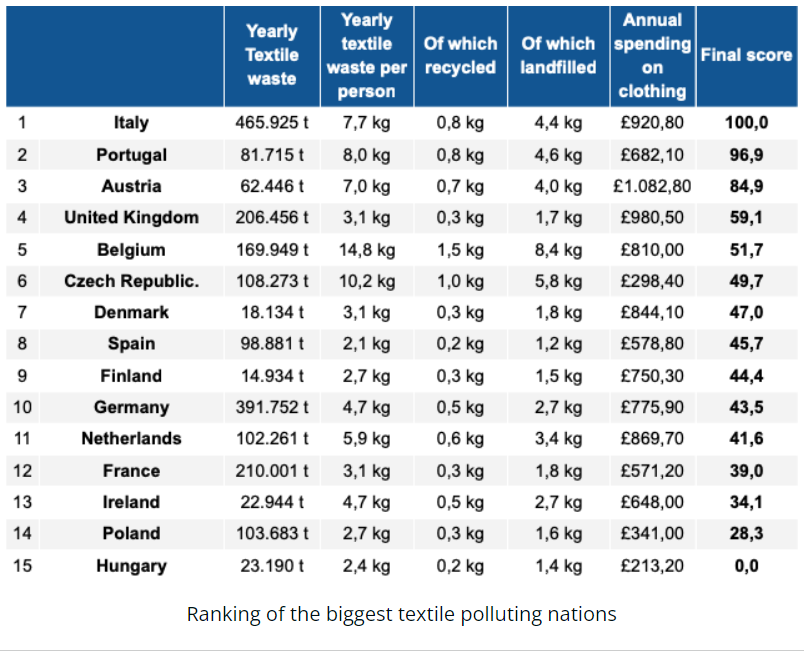
Considering that one of the biggest trends of 2023 is upcycling in the fashion industry, it may be a short-lived trend as people nowadays have a short attention span when to comes to fashion trends, they swiftly move on to the next one.
Maheswari said that older generations might feel that they have good quality, branded items that are worth repairing and to be re-worn rather than buying new clothes. The younger generation are also the ones who are motivated to aim for a conscious way to shop, as it has become part of this year’s trend.
“I don’t relate a trend to repair and recycling, they are not the same parallels. I would say that repairing swapping and recycling clothes is more of a movement where customers are starting to care more about what they have,” she said.
Vintage and designer clothes shops abound in London, for example, GOOD London in Notting Hill nsells clothes that are handpicked by the store manager, varying from designer to premium British brands. The clothes are not only second-hand but also some of them are made using recycled materials.

Many brands encourage sustainable shopping habits simply by providing replacements to new clothes with old clothes that have been tailored for purchase as ready-to-wear pieces.
Circular fashion is a way to encourage people to live sustainably by looking within their own wardrobes, giving their old clothes new life and a chance to be worn and loved again, all the while saving the environment and the planet from the waste that is being thrown in landfill every year in the UK.
Leave a Reply