

By Rosa Renzi
The Museum of Homelessness (MoH) recently reopened its doors for the Spring and Summer season to people interested in learning about the issue of rough sleeping in the UK.
Placed right in front of Manor House station in North London, the Museum shields and cherishes memories of people who experienced or are currently still experiencing homelessness and rough sleeping in the UK.

Co-founder Jess Turtle, visitor Mike Findlay-Agnew, donor Paul Atherton and Co-Founder Matt Turtle at the front of the MoH. Photo by Rosa Renzi
The MoH was founded in 2015 by Jess and Matt Turtle, and is run by volunteers, some of whom have had direct experience of being without a place to call home.
Entry is free, but donations to support the space, the events and the volunteers are welcome.
“It is the first museum of its kind in the world,” says Mrs. Turtle. It stores 38 objects that have been donated by people who struggled or are still struggling with the issue of being without shelter in the UK.
Every object has a deep meaning for the person who has donated it and would like to find a safe space for it and for the story that is behind it.
That is what the Museum of Homelessness does. It gathers 38 objects in one cozy space and their 38 different stories.
Each story is performed live in front of the visitors. However, as it is not meant to “put people on display”, Mrs. Turtle says, different actors tell the stories performing a monologue written by the donors, and that the performers can hear through a set of headphones they use during the show.
Mrs. Turtle adds that “it is a museum of homelessness, not for homeless people”, that is why they decided to keep the names of the donors anonymous, and instead having someone else tell their story.
The visit to the MoH is free and lasts approximately an hour, as soon as visitors do not decide to spend some more time chatting with the volunteers and chilling in the lovely garden they have been restoring from scratch.
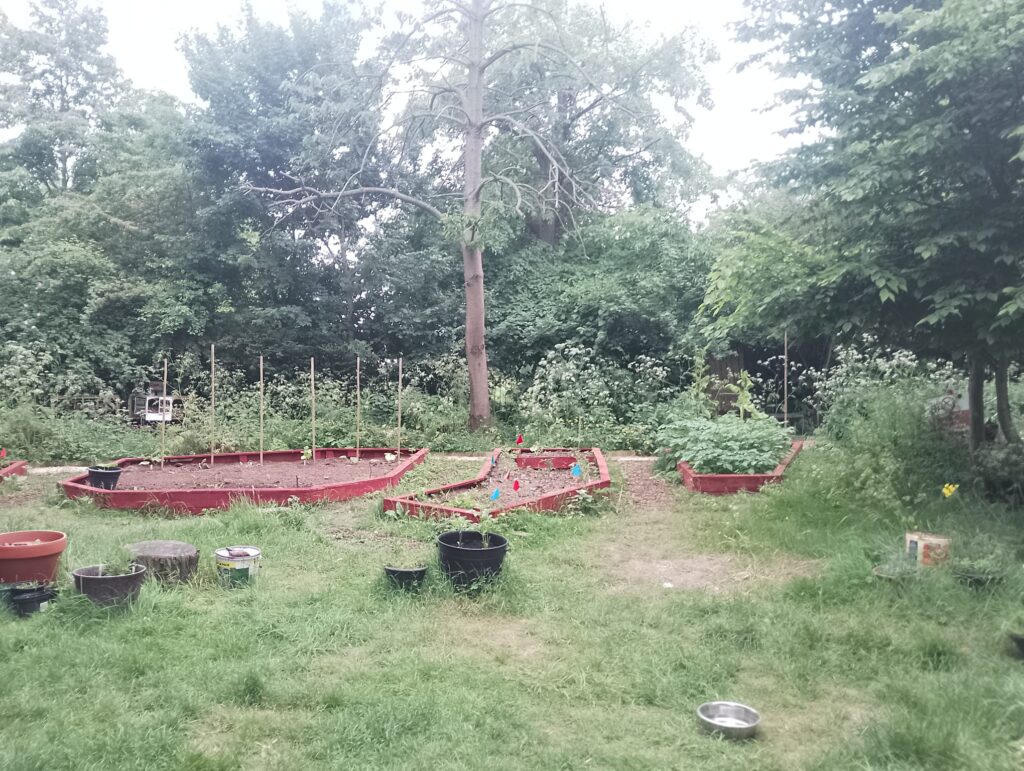
Community Garden at the back of the MoH. Photo by Rosa Renzi
Each visit is guided by a host/performer. They all start with the projection of a 10-minute video where the audience is creatively introduced to the theme of homelessness in England and the work that the Museum is doing to tackle the issue.
Then the host takes the visitors to the room where the objects are stored, and three stories are ready to be told.
It is a small, but cozy space, and that is one of the reasons why they ask to pre-book online.
Belonging somewhere
Lewis Brown is one of the performers who volunteers at MoH, and he acts in six different stories, including one about the value of little things when someone owns nothing else, another about the passive acceptance of what has now become legal, and another one about the joy to remember the times when someone used to belong somewhere.
Each visit has three different stories, but the stories are not always the same, so people can come again to hear more stories if they wish.
One of the donors stepped forward and decided to identify himself. His name is Paul Atherton, 57, and he donated to the Museum of homelessness a Lapsang tea box with one tea bag left inside.
Atherton is a filmmaker originally from Wales and currently based in London, where he is still experiencing homelessness – and has been for years.
He wrote the story that he shared with the audience at MoH during the pandemic, while, for the first time in years, he was able to sleep in a hotel room, following the introduction of the Everyone in Scheme in the UK, which allowed thousands of rough sleepers to finally get a roof above their heads.
“People can be self-centered, and they stop thinking as a community, Covid made people think as a community again,” Atherton said.
However, at the time the story was written, there was only a week left before the end of his stay in that hotel in West London, which meant him going back on the streets like many other people, as the pandemic was over.
Sleeping at Heathrow
Atherton has said that he is still rough sleeping at London Heathrow Airport, but that his creative work relating to homelessness and rough sleeping in the UK has been growing over the years.
London is a unique city in that sense, he said. He can rely on people and communities that welcome and host people without a home and make them feel less isolated – he once found himself sleeping in a theatre overnight.
However, it is a very unsettled life, and, as Covid has demonstrated, it can be fixed, but the question is whether the UK government wants to solve it, which leads to a more complicated issue.
The Museum of Homelessness not only educates visitors about rough sleeping issues and what it means to be without a home, but also offers a community where people can share their experiences and show off their creativity.

Another section of the Community Garden. Photo by Rosa Renzi
The charity is also campaigning to end homelessness in the UK once and for all and has also been involved in investigating the rising number of deaths of rough sleepers a few years ago.
The MoH is a place where the unseen and unacknowledged can find shelter and recognition.

MoH T-shirt who is sold at the venue. Photo by Rosa Renzi
+ If you are experiencing homelessness, please contact: Centrepoint, Shelter, Crisis.
Leave a Reply