

The consumption and disposal of clothing in the UK is an increasing problem, especially when most of us are so addicted to fast fashion. With the fashion industry constantly evolving, this issue will grow greater unless we act now.
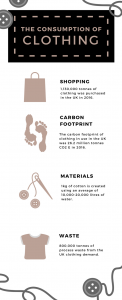
The more clothes we buy the greater volume of clothing we hold; leaving unworn clothes left in our wardrobes that we then dispose of. In 2016, UK households binned 300,000 tonnes of clothing, having the fourth largest environmental impact after housing, transport and food. This shows the significant impact that clothing is having on our environment.
How much a consumer buys is not the only pressing issue; it’s the disposal of the material once we are done with it.
This spring we are expected to get rid of 680 million pieces of clothing, meaning garments will be thrown away, recycled, re-furbished or sent to a charity shop. If not disposed of correctly, the impact of clothing waste can be damaging to the environment.
Even though the number of clothes we send to landfill has decreased over the years, we are still expected to send 235 million items of to landfill this spring. Three-quarters of consumers admit to binning their discarded garments, with the average person disposing of 19 items with seven of those going straight in the bin.

The more garments that are produced, the bigger the impact on the environment. The natural fibres which are grown – cotton or wool- can be agriculturally damaging as more chemical pesticides are used for the growth of these materials than any other crop. The production of non-natural fibres from petrochemicals also have a major impact, as the production process releases nitrous oxide – a greenhouse gas which is 310 times more damaging than carbon dioxide.
The production, however, is only a small part of the problem, as it is estimated that only 30% of the items in our wardrobes have been worn.
This has to change. The first course of action must start at the top of the chain; where we buy clothing and how we buy clothing. It is suggested that in order to face this problem head on we have to address the issue where it all starts.
The most obvious answer is to know how to buy clothes that are going to last you longer, as on average we spend a whopping £1,700 per household a year on clothes. We also have to change our attitude toward fashion; be willing to wear items that are seen as “last season”.
“I absolutely think fast fashion is the main reason why we consume so much fashion. Fashion has never been so affordable and accessible. There’s no incentive for consumers to reuse an old dress they have or fix one when it’s broken when you can buy something new for so little,” said Olivia Pinnock, freelance fashion writer and lecturer.
So how can we change this? “Firstly, we need to educate ourselves and help to spread the word to create more conscious consumers. Secondly, we need to raise these issues in governments around the world and with organisations who aim to tackle environmental issues such as the UN in order to create agreements and make targets to reduce waste,” said Pinnock.
“Thirdly, we need brands to engage with these initiatives and we need to put pressure on them to act as quickly as possible to be more responsible sellers.”

Love Your Clothes will help you do exactly that; love your clothes for longer. An organisation launched in 2014, the campaign was developed by industry experts who wanted to help change the way UK consumers buy, use and dispose of their clothing.
Their ultimate aim as stated on their site is to reduce the environmental impact of clothing across the UK by improving the sustainability of clothing across its lifecycle, while influencing consumer behaviour.
Another action we can take is to learn about consumer behaviour and better our understanding of how to dispose of clothing effectively. Stores all around the country have set up donation bins inside their stores to encourage their customers to donate their clothes and dispose of them correctly. In partnership with Oxfam, Sainsbury’s are one of the retailers who have their collection points alongside their traditional recycling bins in their store car parks.
Sainsbury’s carried out a survey on 2,000 people whereby, 49% of them said they did not think they could donate clothes that were unworn or dirty with a further 16% stating that they simply did not have the time to visit a charity shop.
So how should we be disposing of our clothes correctly? Jean Hughes, Recycling and Support Officer at Environment and Regeneration Department at Islington Council said: “Residents should take clothing in good condition to charity shops, cloth swaps and clothing banks or pass on to someone e.g. friend or eBay. Poorer quality clothing and textiles can sometimes be recycled in clothing banks and household recycling centres.”


What’s in store for the future? According to WRAP, an organisation who have launched SCRAP 2020, a campaign to help bring together forward-thinking organisations from across the clothing supply chain to reinvent how clothes are designed and produced, to re-think how we value clothing by extending life of clothes and to redefine what is possible through re-use and recycling.
They have been making good progress since 2012 but moving forward they hope to help change the mind-set of consumers in extending the life of clothes which will be achieved by designing clothes to be more durable and by encouraging re-use through sales of second hand clothing. They also want to change the way in which high volume products are consumed and produced as women’s jeans, dresses and jumpers are of the highest volume clothing that we produce in the market today and they want to work to improve their sustainability particular the amount of water used in the production.
Finally, you can dispose of your clothing in your own community. Islington Council state that you can recycle your unwanted clothes, textiles and shoes at the cycling points listed below. They provide specific banks for clothing and shoes situated in the North, South, West and East in Islington. They also state that once the clothing is disposed of some are reused while others are re-manufactured either within the UK or across the globe. You can also find more information on www.wrap.org.uk and www.loveyourclothes.org.uk.
Leave a Reply