

By Simran Gill
On a crowded night out in Shoreditch, outfits are currency. Corset tops, leather jackets and carefully curated “effortless” looks all say something about who you are, or at least who you want people to think you are. Outside a bar, a group of students compare outfits while waiting for an Uber.
One girl is asked where her jacket is from. “Just online,” she shrugs casually, cutting the conversation short. What she does not mention is that it cost £6 from a charity shop in Camden earlier that week.
In London, fashion works as social shorthand. Before anyone speaks, clothes have already introduced them. In neighbourhoods like Shoreditch, Soho and Dalston, style is tied to identity, creativity, and status all at once.
For Gen Z, growing up online has only intensified that pressure. Outfits are photographed, posted and archived constantly. Looking original matters, but so does looking current. Sustainability may be fashionable in theory, yet admitting something is “second-hand” can still feel surprisingly complicated.
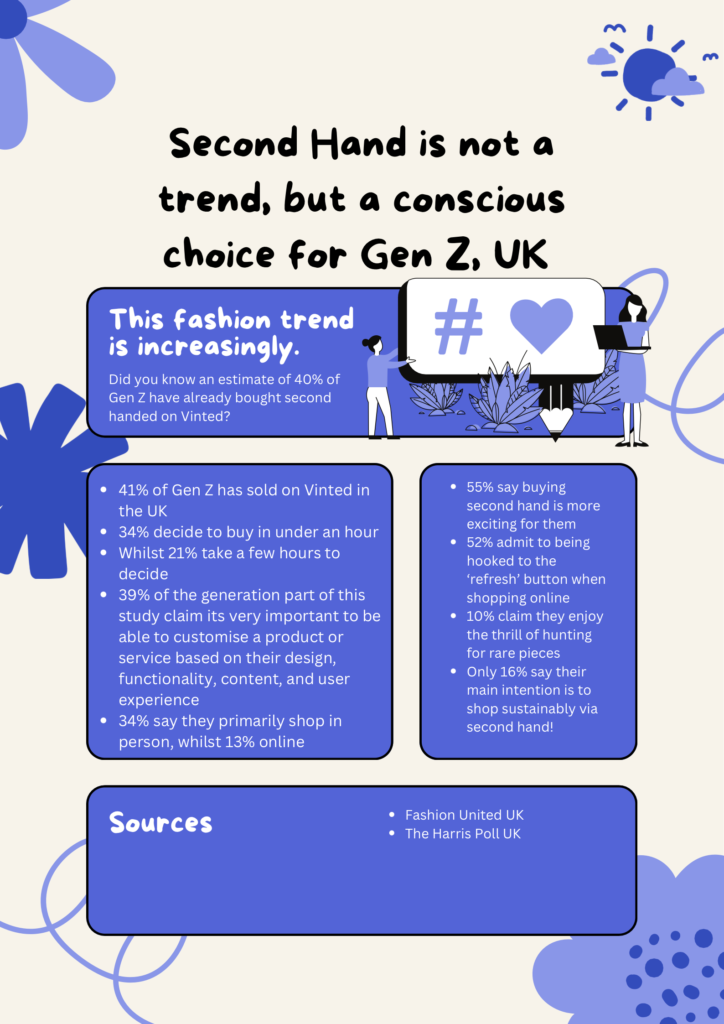
That contradiction sits at the centre of how many young Londoners approach fashion today. Gen Z is often described as the most sustainability-conscious generation yet, and resale culture has become impossible to ignore. Depop and Vinted dominate young people’s phones, while charity shops and vintage markets across London are full of students searching for oversized denim, leather jackets and rare archive pieces.
But despite the rise of thrifting culture, there is still hesitation around the label itself. “Vintage” sounds stylish. “Preloved” sounds curated. “Second-hand” can still carry a quiet sense of embarrassment.
An Instagram poll aimed mostly at Gen Z respondents revealed how conflicted attitudes toward second-hand fashion still are. When asked how they feel telling someone their outfit is second-hand, 92 per cent said they felt proud, while only 8 per cent admitted feeling embarrassed.
On the surface, the stigma appears to be disappearing. Yet conversations with students, sellers and fashion educators suggest the reality is more complicated. Young people may support sustainability, but they are still navigating ideas of status, appearance and social perception at the same time.
Values and behaviour
Karen Coughlan, Senior Lecturer in Fashion and Textiles at London Metropolitan University’s School of Art, Architecture and Design, sees that tension regularly among students. Although she stresses that her expertise is in design rather than consumer behaviour, she has noticed what she describes as a “gap between expressed values and behaviour.”
According to Coughlan, students consistently express concern about climate change and sustainability while still heavily engaging with fast fashion brands. “They’ve grown up in a system of hyper-availability and low pricing,” she explains. “Fast fashion is so easily available, with less curation.”
In London especially, where trends move quickly and appearance matters socially, sustainable intentions are often competing with convenience and affordability. Platforms like TikTok and Instagram accelerate trend cycles at a relentless pace, encouraging constant reinvention online.
The contradiction is not hidden anymore. Many young people are aware they are consuming too much fashion, but they also feel pressure to keep up visually, especially in social spaces where appearance carries cultural value.
That pressure is something Grace Van Veen has noticed through selling clothes online. The 19-year-old second-year architecture student runs Depop and Ebay accounts alongside university, reselling second-hand clothing to predominantly young buyers. She says attitudes toward resale fashion have changed dramatically over the last few years, particularly among students in London.
“Definitely more people are open to second-hand fashion now,” she says. “But the concept always circles back round to ‘new without tags’. There’s still a stigma surrounding the term ‘second-hand’ or ‘used’. Most people would rather refer to it as ‘vintage’.”
Her experience reflects the way second-hand fashion has been rebranded through aesthetics. Shopping resale is considered fashionable when it feels curated, rare or trend-led, but less so when associated with necessity. Historically, second-hand clothing carried associations with poverty and practicality, and traces of that perception still remain.
Patience and effort
That idea of “safety” comes up repeatedly. Fast fashion offers predictability: clean presentation, current trends and easy sizing. Second-hand shopping requires patience and effort.
“There’s also a design and aesthetic issue,” Coughlan says. “Second-hand requires time, an eye and understanding. Not all garments available align with current fashion trends.” In a city where style is often tied to social belonging, shopping sustainably can feel riskier than simply ordering something new online.
At the same time, second-hand fashion has become deeply connected to status in its own way. Van Veen believes younger consumers are still driven by social signalling, even if the markers of status have changed.
“Traditional status, luxury logos and price, has shifted toward cultural capital, styling ability, scarcity and uniqueness,” she says. “Wearing vintage can signal coolness as well as ethics. Avoiding fast fashion can signal awareness. But this doesn’t necessarily reduce consumption, it just shifts it.”
That shift is visible across London’s resale culture. In places like Brick Lane Market or vintage shops in Notting Hill, shoppers are not only searching for affordable clothing but for individuality. A rare jacket or archive pair of trainers carries social value because nobody else has it.
The Instagram poll reflected this too. When asked their main reason for shopping second-hand, only 27 per cent selected sustainability. Meanwhile, 35 per cent said they shop second-hand because it is less expensive, while the largest group, 38 per cent, said they do it to find rare pieces. The results suggest that environmental concern matters, but individuality and exclusivity matter just as much.
Labels and aesthetics
Van Veen sees this clearly through what sells online. “Buyers will seek out known or designer brands, but no-name brands don’t have the same visibility,” she says. Even within sustainable fashion spaces, labels and aesthetics still shape value. The rise of resale culture has not removed fashion’s focus on status — it has simply changed the language around it.
For 20-year-old fashion design student Okechi Nwadike, however, second-hand fashion no longer feels embarrassing at all. Asked whether he would openly tell friends or post online that his outfit was second-hand, he answers immediately. “Yes, because I feel like second-hand clothing is normal in today’s society, especially if you want pieces no longer available.”
Like many Gen Z shoppers, Nwadike is drawn to resale fashion because it offers access to rare items that cannot be bought new anymore. He references pieces like the Jeremy Scott x Adidas Wings 3.0 “Solid Gold” trainers as examples of fashion people actively search for through resale platforms.

By Okechi Nwadike, No/Faith Studios Astro Fur Jacket Camou Leather, £800, Depop

By Okechi Nwadike, Jeremy Scott x Adidas Wings 3.0 ‘Solid Gold’, £700, Ebay
That search for uniqueness is one reason second-hand fashion has become so attractive to younger consumers. In an online culture where algorithms push the same trends repeatedly, thrifting offers the possibility of originality. Walking through vintage shops in East London, it becomes obvious that many young people are not simply trying to dress sustainably; they are trying to avoid looking identical to everyone else.
The Instagram poll results reflected how normalised some aspects of second-hand fashion have become. When asked whether they would wear thrifted shoes, 96 per cent of respondents said yes, despite shoes once being considered one of the least desirable second-hand items because of hygiene concerns.
Platforms like Vinted have also overtaken older resale sites among younger shoppers. Nearly half of respondents said Vinted was their most-used second-hand platform, suggesting resale fashion is now embedded into everyday shopping habits rather than existing as a niche alternative.
Back in Shoreditch, where the night began with hesitation over a charity shop jacket, that tension still feels unresolved. Young Londoners are more open about second-hand fashion than previous generations, and the stigma surrounding thrifting is clearly weaker than it once was. Yet the pressure to look polished, current and socially aware has not disappeared. Instead, resale culture has become woven into those same pressures, shaped by trends, status and aesthetics as much as sustainability.
Still, something is changing. The fact that young people are openly discussing resale fashion, posting thrift hauls online and building personal style around second-hand clothing suggests the stigma is slowly losing its grip. In London, where fashion has always been tied to reinvention, second-hand clothing is no longer just a practical choice. Increasingly, it has become part of how Gen Z defines style itself.
The poll showing 92% feel proud but the subtle language shift—
That 92% claiming pride in the poll feels like an aspirational number rather than a lived reality—the real hesitation shows up in the little shrugs and deflections mentioned earlier. It’s almost as if admitting something is second-hand still requires the right buzzword like “vintage” to feel safe.