
By Ismail Reddy
For the majority of the year, London boasts bitter freezing weather and heavy rainfall. When the summer finally comes around, in comes the music festivals.
If you look on the internet, there are literally hundreds of articles about how music festivals like Wireless and Lovebox are part of our fantastic “culture”, working hard to “bring communities together”. But as residents of areas where the festivals are held proclaim, this does not show the whole story.
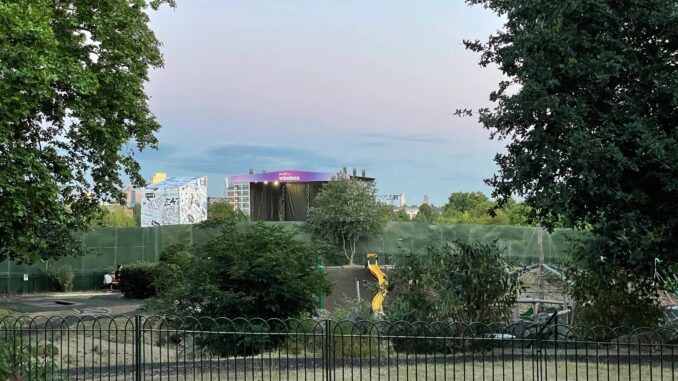
In places like Finsbury Park where I live and grew up, the Wireless Festival took place from 2014 – 2019, and since then a lot of other concerts have taken place, attracting thousands of people. You will find that this is mostly residential area, where many families with young children live.
Festivals such as Wireless bring in around 45,000 people who are very inconsiderate and loud, leaving litter behind and making a huge mess. And let’s not not mention that the festivals run until really late, and so families with young children and the elderly have to put up with this at night.

Men urinating in family gardens
Foziya, 51, a resident of one of the surrounding streets said that on Friday 15th July she went out at around 10pm because she needed some last-minute things from an off-licence store. It took her two hours to get back home because of the number of roads that were closed for the sake of the festivalgoers.
She also said that on her way she had seen a line of men urinating in the gardens of residents, many of which are privately owned.
“Drunkenness and lewd behaviour like this make it a public menace to the residents and for anyone who needs to get about with their daily lives,” said Foziya, who did not want to give her surname. “Whether you are a parent or elderly person trying to shop or a driver trying to make deliveries or drop-offs, these festivals make it harder on everyone.”
Drug use problematic
There is also the added problem of drug use surrounding these music festivals. As a resident myself, I have noticed that that grounds around local homes are always littered with silver canisters that, I have come to learn, contain nitrous oxide which has serious implications on the health and immune systems if used too much, including the depletion of white blood cells which fight off disease in the body.
In his evidence to the government, Dr Andrew Smith of Westminster University spoke about alcohol and drug abuse at UK park festivals. “Some of the local groups I spoke to said they had fought for years to rid their local park of problems associated with drinking and drug-taking and regarded the recent introduction of music festivals as something that undermined their work,” he said.
In view of this, many residents in the Islington and Haringey boroughs are annoyed with the negative effect that these events have on their communities. In fact, a group called The Friends of Finsbury Park has now started an online petition called “Hands Off Our Park” which has already garnered more than 1,800 signatures.
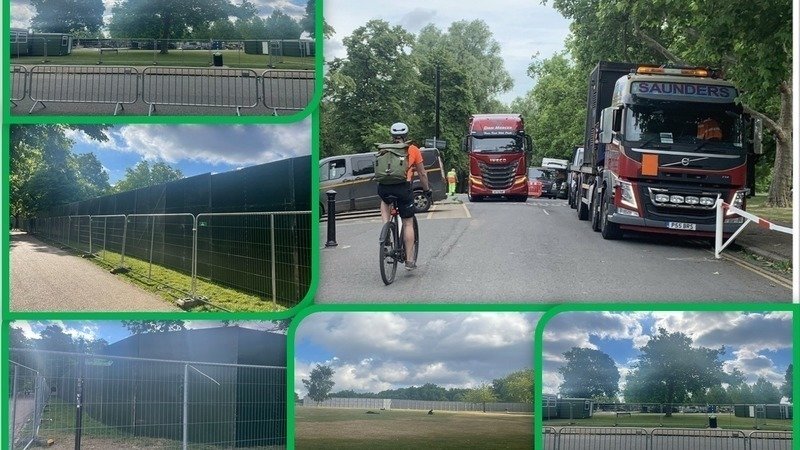
A point that that the group has raised for many years is that the park is a safe haven for local communities to gather and relax, especially those who don’t have gardens due to their housing situations. For a whole month in summer parks become cordoned off for these events, usually including the most popular parts of the park right next to the children’s play areas. In addition, tennis courts are closed off for the entire month due to these events.
Becoming a wasteland – literally
And that’s not all. The damage festivals do to the parks and the environment is immense. Festivalgoers and concert-junkies trample the grass and litter it beyond comprehension. With the lack of rain in the summer, after these festival-goers finally leave, the park grounds are often left completely ruined. The grass is left yellowing and patchy, and the park is full of litter that costs council funds to clean up.
According to a 2021-22 House of Commons statement for festivals: “UK festivals generate 25,800 tonnes of waste, 22,876 tonnes of CO2 and use 185 million litres of water annually. 125 festivalgoers produce 2kg of waste per person per day.” It says that is “nearly twice as much as is produced per person per day from household waste”.
This statistic is taken from an organisation called ‘The Show Must Go On’ as a part of their Vison 2025 initiative to tackle environmental sustainability at festivals. However, since we are in 2022, and the situation hasn’t been improved, its is unlikely that much will be done in the next three years.
While music festivals may bring in money, they don’t really bring in much money for community businesses, only the ever-growing chain stores and the event organisers who are making cold, hard cash from them. With ticket sales at these year’s Wireless festival at £132 for a single day, plus the money from vendors, event organisers are bringing in around £6m a day, and only 4% goes to the council funds.
While these festivals offer the council enough money to sustain the park for the year, it has become an issue, especially after the Covid-19 pandemic where there were no large events allowed. And with the strong shift towards reducing carbon emissions and sustaining the environment, experts are wondering whether this is a reliable source of funding for the parks.
Local pain
One of the petitioners, Donna Fenby Taylor writes it is “Too much local pain for too little gain financially.” The organisers of Friends of Finsbury Park feel the same way, they are more than happy to allow smaller events at the park that do not assume as much space and also that don’t stay at the park for such a long duration and damage the grounds.
Dr Smith at Westminster University says that the pandemic offers “scope to think more imaginatively about where urban festivals are held”. For example, “the relocation of the Field Day festival from Brockwell Park to an industrial site, Meridian Water in Enfield” shows that “successful festivals can be staged in brownfield sites, private estates, or stadium venues: they don’t have to be staged in green spaces or public parks”.
I agree with this whole-heartedly. Purpose-built places like the O2 Arena in Greenwich or the London Stadium at Queen Elizabeth Olympic Park can cater to these festivals and will help to sustain the environment as well, because the amount of diesel fumes from HGV’s carrying walls and fixtures will be greatly reduced, as will the damage to the parks and congestion around them which are mostly in heavily populated metropolitan areas.

In response to this, Julie Davies, Labour’s cabinet member for communities and civic life, defended these music festivals and events, and said they “bring world-class music and entertainment for Haringey residents and thousands of visitors from across London and beyond”. She went on to say that “Finsbury Park has a long history of staging big events, and with Covid restricting the lives of our young people for so long, music events like this help bring our communities back together to appreciate arts, culture and music”.
But that’s just it. Covid-19 did change things. Young people aren’t the only ones who were restricted and not allowed to go anywhere, so were the rest of the community. Many of the elderly were isolated at that time, and many children were born and/or raised in “Covid captivity”. The parks were a refuge for young families, the elderly, dog owners and anyone who was struggling who needed space.
History needs to change
As Dr. Smith has said, the parks became an integral space for the community, especially as many residents don’t have access to gardens. The park is shared by not one but three boroughs: Haringey, Islington, and Hackney, which boasts some of the poorest people living in inadequate housing with no gardens and extremely little green spaces. Finsbury Park may have a “long history of staging big events” but history needs to change.
The council had no problem installing LTN’s (low-traffic neighbourhoods) everywhere, saying they consulted the residents beforehand, although people I have asked say they heard nothing. But when it comes to something that has to do with public spaces and events that will affect the public, we weren’t consulted at all.
I understand that the park needs to make money, but loud music festivals in the middle of a metropolis is not the way to go, especially after Covid-19 where people have reconnected with their green spaces and relied on them for relaxation and mental sanity.
This year, the effect from the festivals was one of the worst I’ve seen, and I’ve lived in this borough almost all of my life. The crowds, the noise, and the littering and drunkenness…something needs to change. The council needs to start asking its constituents what they want to see in their green spaces, and organise environmentally friendly events that everyone can enjoy, not just a select demographic.
Leave a Reply