
By Gabriela Yorgova and Umme Capa
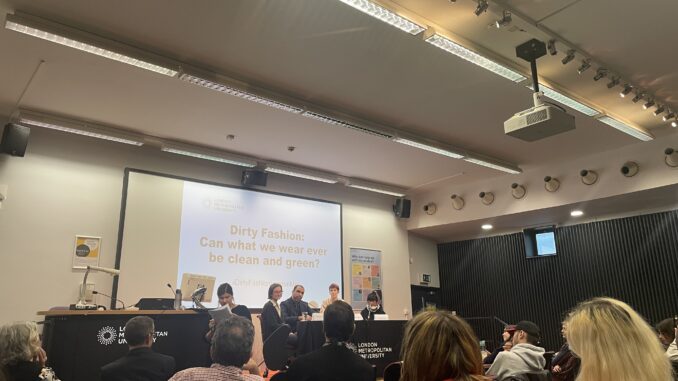
London Met’s journalism Newsweek “Dirty London: can what we wear ever be clean and green?” gathered a group of guest speakers who questioned the complex relationship between fashion and environmental sustainability.
Each of the panellists brought a unique perspective to the conversation on sustainable fashion. Experts from the fashion industry included designer and entrepreneur Omar Mansoor, former Vogue Ukraine Sustainability Editor, Tetyana Solovey, fashion designer Shama Kun and fashion journalist Olivia Pinnock, who were invited to talk about their experience with fashion ethics and sustainability.
16:55 – Panellists have arrived and are ready to start the fashion event – Dirty Fashion: Can What We Wear Ever Be Clean and Green?
16:59 – The guests sit down in their designated seats.
17:01 – London Met Journalism Course Leader Wendy Sloane introduces the panellists to the audience.
Wendy introduces London Met lecturer Sasha Raspopina as the host of the panel event.
17:02 – Sasha introduces the London Met Newsweek, Dirty Fashion, citing facts about fashion industry is polluting the world.
17:08 – Sasha introduces the panellists.
17:08 – Guest speaker Tetyana Solovey, a Vogue Ukraine’s first sustainability editor, introduces herself as an experienced editor who worked for Vogue Ukraine.
She expresses her sentiment about the Rana Plaza collapse in 2013, and that’s when she “began to dig into the sustainability more deeply”.
17:10 – Guest speaker and fashion designer Omar Mansoor greets everyone.
“Labour should be paid well, and the working consumption should be good,” says Omar.
17:11 – Guest speaker Olivia Pinnock introduces herself.
The fashion journalist says she is interested in ‘green’ fashion: “The more I dug into it, the more I realize there is this huge problem happening in the fashion industry that no one seems to be talking about.”
She also expresses her sentiment towards the Rana Plaza factory collapse, and how hard it has been to talk about fashion when there had been no coverage about sustainability in the industry.
17:13 – Guest speaker Shama Kun introduces herself and shares more about her work as a sustainable fashion designer who is implementing her Bangladeshi heritage into her designs and clothing pieces.
“I want to be part of this industry but not in an ugly one, where people are being exploited.”
17:14 – Sasha asks the first question to the whole panel: “Affordability is quite often used as a defence against buying fast fashion. Why do we feel an entitlement to trends?”
17:15 – Olivia says: “Dignity is being able to wear the latest trend because it makes you in fashion, it makes you a stylist.” She adds that this need is manufactured by the fashion media and that it is feeding us with a lie that we need to buy the latest trend.
“We’re so used to fast fashion brands offering student discounts. Why don’t they offer discounts to people on benefits? It’s because they believe you have money and you will continue to shop for them,” she says.
17:17 – Shama questions the audience “Do we need to follow the trend? Can we create our own individual look?”
She believes no one should follow any trend, everyone should follow themselves because we are all our “own individual, all look into yourself”.
17:18 – Tetyana responds: “Historically, fashion was an industrial revolution.” It was designated for wealthy people; therefore, it wasn’t made for everybody.
“But when fashion became popular people wanted to live more fashion and dress themselves very fashionable” and that’s when fast fashion was created for more accessibility for everyone who wants to follow the trend.
17:20 – “That’s where the issue is coming – people prioritizing their £4.50 top instead of a coffee,” says Omar.
He explains how Boohoo sells clothes for £1.99, and people will buy them without caring if the people doing the labour are being paid enough.
17:21 – Fashion journalism student Grace asks: “How do you define sustainability in the fashion industry?”
17:22 – Tetyana explains how she perceives sustainability: “We need to consider three factors: how we impact the nature, how the community benefits, and how people address ecological and ethical needs.” These are the key factors Tetyana explains when we consider fashion sustainable.
17:24 – Omar shares his opinion that sustainability starts from home. He gives an example of his upbringing in Pakistan, where reusing food and clothing is a way of lifestyle.
17:25 – Shama adds that sustainability is a practice. “You must challenge yourselves, challenge everything by asking yourself where the t-shirt you are wearing is coming from. The cotton… where is it growing?”
Shama advises the audience to investigate where their clothes are coming from, to be interested in what they are wearing and, in that way, to appreciate their clothes and re-use them again.
17:25 – “Currently, fashion mostly benefits businesses and rich people,” Olivia says. The fashion journalist suggests that clothing makers should also be considered, which would make companies realise how important sustainability is for the environment.
17:26 – Shama says: “The fashion industry is designed in such a way that alienates the customer from the production.”
17:28 – Journalism student Maria asks Shama and Omar: “What do you do to make sure your clothes are sustainable?”
“I look for my own resources, and I use biodegradable resources,” Shama says.
She shares her views on the importance of knowing the origin of the materials, which helps with tracing the manufacturing process of a piece.
17:30 – Omar responds that sustainability was a challenge for him at the beginning of his career until last year, when it had become easier to source sustainable fabrics.
“I keep an eye on who are producing, and in which condition they are producing.” He shares how sustainability and textile fairs have eased the way fabrics are chosen and bought.
17:31 – Student Laura asks Olivia and Tetyana: “As future fashion journalists, how do we cover fashion responsibility and make sure we don’t contribute to the promotion of fast fashion and microtrends?”
“It’s a profession that now requires more expertise and more coherent resources into the topic,” says Tetyana, who also explains how the industry has changed. She adds that it’s much easier to find ethical and moral sources before writing any article about fast fashion.
17:34 – Olivia comments on the pressure that media outlets have from brands. She adds that traditional media avoids featuring vintage and second-hand clothing because companies are pressuring them to constantly feature their new products. She also explains that “it takes a big effort to do all this because it is important to consider your career”.
17:36 – Student Aliyah asks the panel: “France has just introduced legislation to clamp down on fast fashion, which may include an advertising ban and taxing fast fashion producers. Is this to be commended, or is this just a greenwashing tactic? And do you think the UK should introduce a similar law?”
17:37 – Omar responds: “That is not greenwashing at all!” He gives as an example the fast-fashion retailer Shein, which claims to be sustainable and doesn’t overproduce.
He shares his hopes about the future of the fashion industry and that it will become more sustainable due to public demand.
17:40 – “It’s actually a good example of how sustainability could be both an economic and business opportunity,” says Tetyana.
“It is in the economical interest of France to ban fast fashion to reduce them all and give the market more to luxury fashion.”
17:41 – Olivia mentions that we “absolutely need regulation.” She adds that the fashion history in France is very advanced compared to other countries, therefore brands should take responsibility for more sustainable fashion.
17:42 – Fashion journalism student Gabriela asks the panel: “Companies lie about their employment practices, especially when the production is overseas and it’s difficult to check. How do we know that a disaster like Rana Plaza isn’t going to happen again?”
Shama explains that she doesn’t practice mass production. She takes orders from the customers and makes one unique piece for the customer only, so she can avoid mass production.
“You see it, you order it, and I will produce it.”
17:44 – Olivia criticises the fashion industry by emphasising this issue, which is happening and will happen again.
17:45 – Shama talks about the case in Bangladesh with underpaid workers, who stay in those factories due to the need for money.
17:46 – The panellists are asked about the issue of inequality as an issue in the fashion industry.
17:46 – Omar says that it is an ongoing issue, not just in fashion. The fashion designer adds that women are being paid less for labour and are being seen as a side income in countries like Bangladesh.
17:48 – Shama says: “95% of workers are female, but they don’t get paid as men… They are skilful.” She mentions recent garment worker protests in Bangladesh, where women have been shot dead.
17:49 – A student asks Tetyana about her work as a sustainability editor at Vogue, the pressures for advertising and the balance.
17:50 – “Ukraine was always a small market for the brand, we were not constrained for the advertising.” Tetyana shares that Vogue Ukraine had more freedom of expression compared to issues of the magazine in other countries.
17:45 – Shama mentions that some European companies force Bangladeshi people to produce faster, and the Bangladeshi authorities also force them to keep working in hard labour with very low paycheques.
This is also the government’s problem because they won’t address this issue and unfortunately encourage companies to keep manufacturing with cheap labour.
17:46 – Journalism student Delphine asks Omar: “You recently celebrated International Women’s Day in Paris, what do you think about the current issue with sweatshop use in fast fashion, is it a women’s rights issue?”
Omar responds that gender equality is an overall issue, not only in fashion. “Women are paid less for their labour because they are seen as a side income and that is an issue.”
Omar says this issue should be addressed more.
17:48 – 95% of workers are in the textile industry, and female workers get paid less than men, even though they have better skills compared to men, mentions Shama.
“That is why they are protesting, from the labour party five women are the leader of these protests, because is a women’s issue.”
17:49 – Journalism student Cydneii asks Tetyana: “How did you convince Vogue to create the sustainability editor position, and what does the position entail? How can you live these values in a fashion magazine that also has the pressures of advertising?”
17:50 – “Ukraine was always a small market for the brand, we were not constrained for advertising,” says Tetyana.
17:51 – Tetyana also mentions that because Vogue Ukraine has low budged there was more freedom for expression.
“We were never that far to talk about tragedies and address issues, but we had a soft touch.”
17:54 – Shama says: “It’s the people we need to question, it’s the business model… That is not working at all, it’s not fair, it’s discriminatory.”
17:56 – Olivia mentions how fashion is pictured always positively.
18:00 – Student Seham asks the whole panel: “What do you think the impact on fashion brands would be if people bought sustainability?”
Omar responds, “If there is demand, there will be supply.”
18:01 – Shama mentions that consumers have the responsibility to look for sustainable brands.
“If everyone goes towards sustainability, the demand will be higher for big businesses.” Olivia adds: “Are we using what we already have? Or are we using different materials? We eventually have so much clothing and we wonder what to do with it.”
18:03 – Tetyana encourages reusing pieces and passing them by to family and friends: “It’s kinship, it’s inheritance!”
18:06 – The Vogue sustainability editor comments on why people shouldn’t be pressured to buy less. “We need to acknowledge the desire to have clothing.”
18:07 – Charlotte, a third-year student, asks the panel: “What do you think of luxury brands destroying their products rather than reducing their price when they’re out of season?”
18:08 – Shama suggests that we can use AI in the future to repurpose a product and make it a niche one again.
18:09 – Omar said: “Sometimes, it might be cheaper to destroy rather than sell it for less.”
18:10 – Shama talks about the unethical side of clothing production as she compares the payment of workers in countries like Bangladesh, to “peanuts”.
18:11 – “It’s inevitably late to reduce overproduction…” Tetyana expresses her views on the imbalance between sustainable fashion and business.
18:12 – Olivia adds: “We are in a climate crisis… and it’s not good for the business.”
18:14 – Omar comments on the role of influencers as people who get paid to advertise a product and attend fashion shows. According to him, it’s “the brand’s responsibility to make sure the product is sold”.
18:16 – Olivia on the regulations of social media: “I think social media needs regulation not only for overconsumption but for other problems considering mental health and more.”
18:17 – Shama shares some insights of her wardrobe. “I buy stuff from a charity shop, I redesign it, and I wear it.”
18:18 – Olivia says she also loves second-hand clothing. However, she finds it hard to find shoes in high street shops that fit her size 10 feet. The journalist adds that she tries to repair her shoes whenever she can, to reduce the waste.

Photo by Wendy Sloane
18:21 – Tetyana gives some tips on how to avoid a “wardrobe crisis”- she tends to buy good-quality pieces, that fit her well, and tries to repair them instead of disposing and buying new pieces.
18:24 – Sasha thanks the panellists.
18:24 – Wendy thanks the panellists and the audience and introduces the catwalk.
18:25 – Catwalk with students from London Met wearing items that are already in their wardrobes starts.
Leave a Reply