
By Minttu Marjomaa
Even with new e-book services, audiobook subscriptions and grim studies of our shortening attention spans, the print book market is enjoying its fourth consecutive year of growth. Last year’s UK bestsellers included Michelle Obama’s memoir Becoming, which sold half a million copies in two months, and Gail Honeyman’s uplifting debut Eleanor Oliphant Is Completely Fine, which emerged as the top seller with almost one million copies.
However, sales at traditional retailers like Waterstones are actually declining. In fact, there seems to be only one company responsible for bringing print back – Amazon. It has achieved a monopoly by offering fast shipping, a large selection and hefty discounts. Those who are hit the hardest by this trend towards online retail are independent bookshops, which can’t compete with the multinationals.
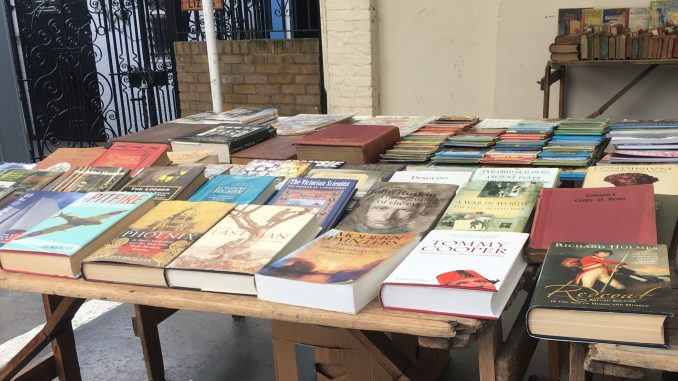
Camden Passage hosts a book market for independent sellers every Thursday. Despite it being a sunny afternoon, there’s only a handful of visitors gathered around the tables. One of them is Shuying Chen, who studies History at University College London.
“I get my uni books on my Kindle but everything else I buy second-hand or from small independent bookshops,” said Chen, 21.
“I think small shops have personality and are more authentic than Amazon or Waterstones. My favourites are the Oxfam Books in Angel and Brick Lane Bookshop in Shoreditch. I like their selection and atmosphere.”
The larger shops, however, such as Waterstones and Foyles in London offer a full shopping experience. They are not just a place to browse but also a place to have a cup of coffee or even lunch. While people might spend 15 minutes in an independent bookshop, they could spend several hours at a book superstore, where they host talks, signings and activities for children.
Despite enjoying the odd look around indie bookshops, most of graphic designer Catherine Barr’s reading material arrives at her door in a cardboard box.
“I’m not super keen to support a company like Amazon but nothing comes close to it in price or convenience. It gives you titles based on what you’ve read and you can buy them for a few pounds and even get them delivered the next day,” said Barr, 32.
“Show me another book retailer that can do that and I’ll switch there!”
Amazon has faced its share of controversies, including allegations of anti-competitive practises, poor working conditions and tax avoidance. Most consumers, like Barr, seem unfazed, given that the company has enjoyed a steady growth since its conception in 1994 and made its founder, Jeff Bezos, the richest man on Earth.
Charlie Parsons, an employee of an independent shop Black Gull Books in Camden Market, admits that they are not able to offer everything the digital giant can but thinks there are still perks of patronizing a small business.
“You can go to your computer and look up a book. Or you can go to Waterstones and ask about a book and they’ll go to their computer to look it up. But if you come here, I can take you to that book right away,” said Parsons.
“Personal service, that’s what we can offer.”
Indeed, many independent bookshops have decided to specialise in a specific genre, meaning that customers can get personalised advice and recommendations from an actual human being who may have read the book themselves.
But Parsons, who has worked for Black Gull Books for 15 years, is worried that people come to his store to browse and not to buy. Most of their customers are students who like to buy English classics by authors like Austen, Orwell and Dickens.
“People used to come here because they knew there was a bookshop here but it’s becoming more and more of a tourist spot. There are these big manufacturers now so customers don’t appreciate independent sellers anymore,” said Parsons.
According to Parsons, Black Gull Books is looking to relocate. The 30-year-old business is struggling to pay the Camden Market rent with a diminishing customer base.
It’s not likely that small bookshops will ever catch up to Amazon’s market share but all hope is not lost for the indies. In fact, 15 new ones opened their doors last year across the UK. Whether customers will find them, remains to be seen.
Credit: Minttu Marjomaa
Leave a Reply