
By Jessica Bashir-Stone
Poor mental health is something that many people are affected by on a day-to-day basis. Around the world, 40 million people have been diagnosed with some kind of anxiety disorder, ranging from mild to severe.
During the coronavirus pandemic a lot of people’s anxiety has worsened. Ken Goodman, a therapist from Los Angeles says: “It’s normal to feel anxious and worried during a national crisis. Don’t be hard on yourself.”
Three main types of anxiety disorders are recognized globally. Getting the right diagnosis is the first step to recovery.
(mental health gif by – Jake Hawkins)
Generalized Anxiety Disorder
The first is Generalized Anxiety Disorder, or GAD, which is ‘a disorder characterized by excessive or unrealistic anxiety about two or more aspects of life.’
GAD affects 6.9 million adults across the world. Fortunately, there are many ways that anxiety like this can be helped, such as self-care, therapy and medication. However, only 36.9% of people who are diagnosed go down the medical route.
Women are more likely than men to have GAD, according to the National Library of Medicine at the National Institutes of Health in Bethesda, Maryland. The main reason, says Andreas Walther, a German author, is hormonal fluctuations. Women are more likely to be stressed, says Marieke S. Tollenaar, a psychology professor at Leiden university.
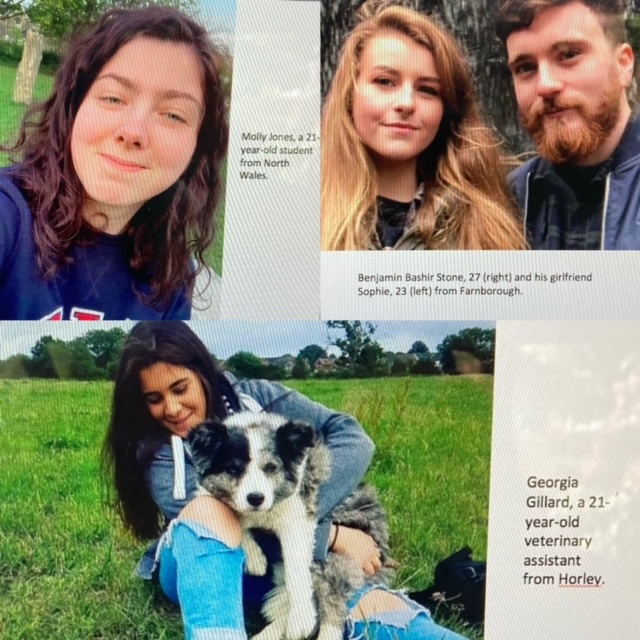
(Collage of Molly, Ben and Georgia by Jessica Bashir Stone)
Molly Jones, a 21-year-old psychology student from North Wales, has had GAD since she was 15 years old. She knew she had anxiety when she was placed into a big room full of all her peers at school and told to do her exams in silence, even though the very thought of being around that many people made her sick to her stomach.
Some of the main symptoms of anxiety are a fast heart rate, sweaty palms, digestion problems, migraine, the feeling of a lump in the throat, shaking and, on rare occasions, blurred vision.
Jones has tried many things to help prevent the anxiety from starting or lessen the symptoms. ‘I first tried mindfulness, anything really that was meditation based and could help calm me down; music worked a lot,’ she says.
‘Medication was never for me. I’d heard so many horror stories I really didn’t want to be one of those people. So, instead of that I just pushed it away.’
The most common form of medication to treat anxiety is a drug called benzodiazepines however, this drug has been shown to cause amnesia, according to AARP.
While medication for anxiety is a life-saver for some people, it also can cause blurry vision, dizziness, fatigue, dry mouth, weight gain, headaches, nausea, sleep problems and sexual issues. Some people have been more likely to avoid this medication due to the severity of the side effects, while others think they can get better on their own people think they can do it themselves, according to MedicalNewsToday.
Jones is passionate about making sure she strives towards peace of mind, and trying to protect those she cares for by making sure the same thing doesn’t happen to them.
‘If someone is going through a hard time like I have I just make sure I’m all ears and try and help them find the best option to get their mental health back on track,’ she says.
‘I’m no therapist but I do study psychology and find it interesting to see how and why the brain works with anxiety.’
Panic Disorder
Panic Disorder, characterised by regular panic attacks, is also common. It affects six million people around the world and again, women are more likely to experience this disorder than men.
Panic disorder is similar to GAD, although the symptoms are usually more intense.
Panic attacks can be hard to spot in a lot of people, and many learn to hide their symptoms, or suppress them until later. One of the most common symptoms is restlessness, which is often mistaken for hyperactivity or just having too much energy. Usually, it is one of the first signs of a panic attack.
Ben Bashir-Stone, a 27-year-old greyhound trainer from Farnborough, has suffered with panic disorder for as long as he can remember. He thinks the panic attacks first started coming in secondary school when he was under a lot of academic pressure.
‘I really enjoyed school,’ says Bashir-Stone, ‘but I found it hard sometimes to not crack under the pressure. I was expected to do my best all the time and became stressed easily.’
He has tried many things to help him deal with his panic attacks, from therapy to buying new animals to help him keep calm. ‘Me and my girlfriend Sophie have loads of animals, we have two greyhounds from work and many reptiles. I think work can be stressful sometimes, but the animals are always there to help, along with Sophie.’
Treatment for panic disorder is very similar to GAD, but many people don’t access it. Bashir-Stone says: ‘I recommend either going to a GP if you are really struggling or just finding what works best for you. Mine is animals, but it could be anything. Drawing works, painting, running, fishing, just whatever suits your personality best.’
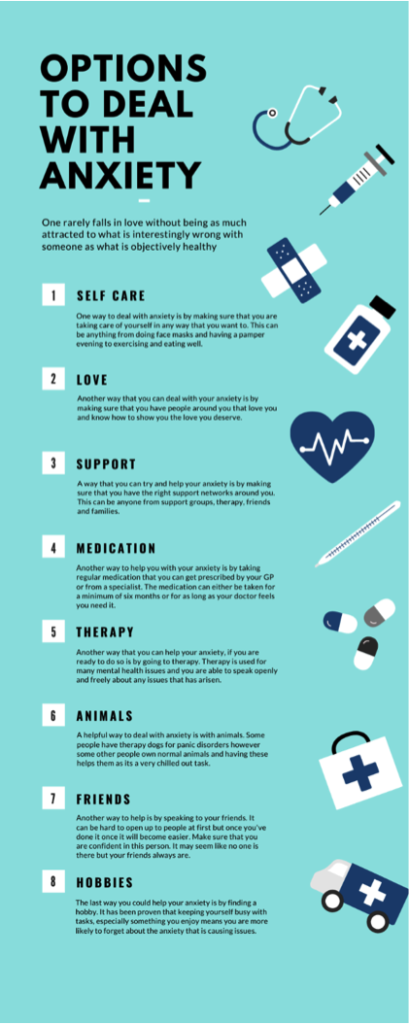
(Anxiety infographic by Jessica Bashir Stone)
Social Anxiety Disorder
People who find it difficult to be in social situations or large groups could suffer from Social Anxiety Disorder, or SAD. They often dislike being the centre of attention and suffer from an ‘overwhelming fear of social situations like meeting or speaking to people’.
Currently, 15 million adults suffer worldwide with social anxiety disorder, says the Anxiety and Depression Association of America. Therapy or medication can help but 36% of people with SAD go up to ten years without any form of treatment, according to the ADAA.
Like the other disorders, social anxiety is triggered by traumatic events, uncomfortable situations, social settings that are large and can be overwhelming or a new learning experience such as driving and going to university.
Georgia Gillard, a 21-year-old veterinary assistant from Horley, has suffered with social anxiety disorder on and off for the last four years.
The first time that Gillard knew she was truly anxious around large groups was when she joined college.
‘If I’m honest, I am still working out what to do about it and how to go about it in the best way. I don’t think people understand how long it takes for mental health to be a thing of the past.
‘I know many people who have social anxiety disorder and it doesn’t make them any different. A few of my friends just need to be told they’ll be okay, but some cannot be in the situation at all, it really is hit and miss.’
Gillard has been working on improving her mental health over lockdown. ‘I felt like if I helped it during lockdown then when we came out it would be easier to deal with and you know what, it did work! Well, to an extent . . . I am still very nervous, but I can face it now, I’m proud of myself.’
Get the help you need
A recent online Instagram poll asked if people had dealt with any of the top three types of anxiety disorders. Here are the results:
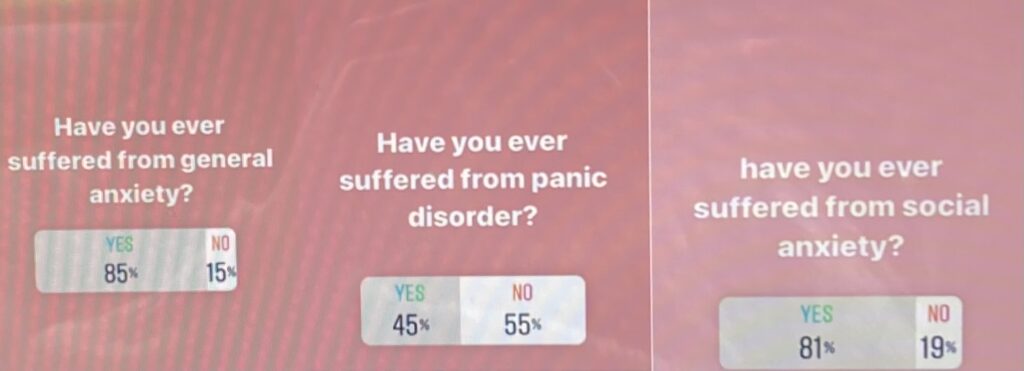
(instagram poll for anxiety by Jessica Bashir Stone)
If you are suffering from any mental health issues and need help, please either contact your local GP or ring 111 for help. Otherwise you can contact the charity ‘Mind’ at any time on 116 123.
Leave a Reply