
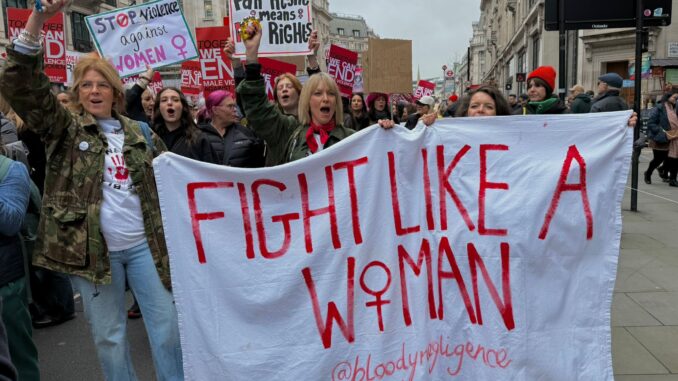
Photo by Niamh Hatfield
By Elspeth Chapman and Niamh Hatfield
March is Women’s History Month, a celebration to honour the roles women play in today’s society. But despite the achievements women have made, they are still fighting for their independence, safety and autonomy around the world, including in the UK.
Thousands of women filled Oxford Street recently, marching together to protest violence against women and girls on International Women’s Day.
Chants rose above London’s busy hum, drums were beating, while signs carried meanings. Women shared their experiences, their voices rising together, while bystanders clapped and cheered. The atmosphere was impossible to ignore.
Video by Elspeth Chapman
And yet, being loud isn’t enough. The people with the power to make real change still need to listen.
This month brings attention to the ongoing fight for women’s rights, a struggle with deep roots in history. From the Suffragettes, who fought tirelessly for the vote, to modern movements such as #MeToo and My Body, My Choice, women have continually demanded recognition, safety, and autonomy. The tragic story of Sarah Everard, who was raped and murdered by an off-duty Metropolitan Police officer in 2021, also reminds us that these rights extend beyond legislation to personal safety and bodily freedom.

At an International Women’s Day march, Emily Duffy, 27, watched as the crowd surged around her. “We aren’t asking for anything new, just what we should have always had,” she said. “It’s all well and good all of us being here at the march but think about how many of us will still have to text a friend that we got home safe.”
For some, it was their first march. Nineteen-year-old Aiza carried a bright handmade sign reading, “We’ve heard enough from old white men.” “This is my first march, but I wish I’d come years ago too,” she said.
Others attended with the next generation in mind. Hector, 34, held his young daughter’s hand as they moved through the crowd. “I’ve brought my little girl with me so she can see how many people are fighting for her future,” he said.
From historic struggles to modern movements, the fight for women’s rights is ongoing, a reminder that equality is not a gift, but something continually demanded and defended.
Movements like Women Against the Far Right and Refugees Welcome show how women’s activism often intersects with broader social justice causes, proving that the fight for fairness and safety is never isolated – it’s collective.
Leave a Reply