

Photo credit: Daniela Forresu
By Daniela Forresu
The most popular and spectacular Carnival celebrations in the world are in Brazil Rio de Janeiro. Pronounced kar-nih-vahl, this protracted festival feature dazzling costumes, boisterous parades, and excess food and drink.
But Italy also has amazing carnival celebrations, with each city bringing its own unique traditions to life. In Venice, for example, Carnival can last an entire month, and is known as the second best carnival celebration in the world.
Deeply rooted in history and culture, Carnival in Italy takes place in the weeks leading up to Lent, seducing locals, and tourists alike with colourful masks, parades, and typical Italian food.
Carnival in Venice: a timeless elegance
In Venice, the Carnival is one of the most iconic in the world, dating back to the 11th century. It became extremely popular during the 18th century, when aristocrats from all over the world attended the annual festival with elaborate masks and costumes to indulge in days of revelry, mystery, and music.

Venice carnival and masks costumes. Credit: Daniela Forresu
Today, Carnival in Venice is still one of the most appreciated in Italy for its theatrical performances, masked balls and stunning costumes. What is behind the tradition?
To better understand the craftsmanship of this tradition, Beatrice Cardaio, 52, a Venetian artisan who works full-time at La Bauta, a historical shop specialised in handcrafted Venetian masks and costumes, explains what Carnival means for Venetians.

Venice carnival dress and mask by Beatrice Cardaio. Credit: Daniela Forresu
’’Creating a mask is not only making something beautiful. But it is all about preserving a tradition that is going for centuries,’’ says Cardaio, who has dedicated the past two decades to creating masks and costumes.
‘’Each mask has a meaning. The ‘Bauta’ was one of the most used by the nobles to maintain anonymity, the ‘Colombina’ is playful and flirtatious, while the ‘medico della peste’ has more mysterious and historical significance.’’
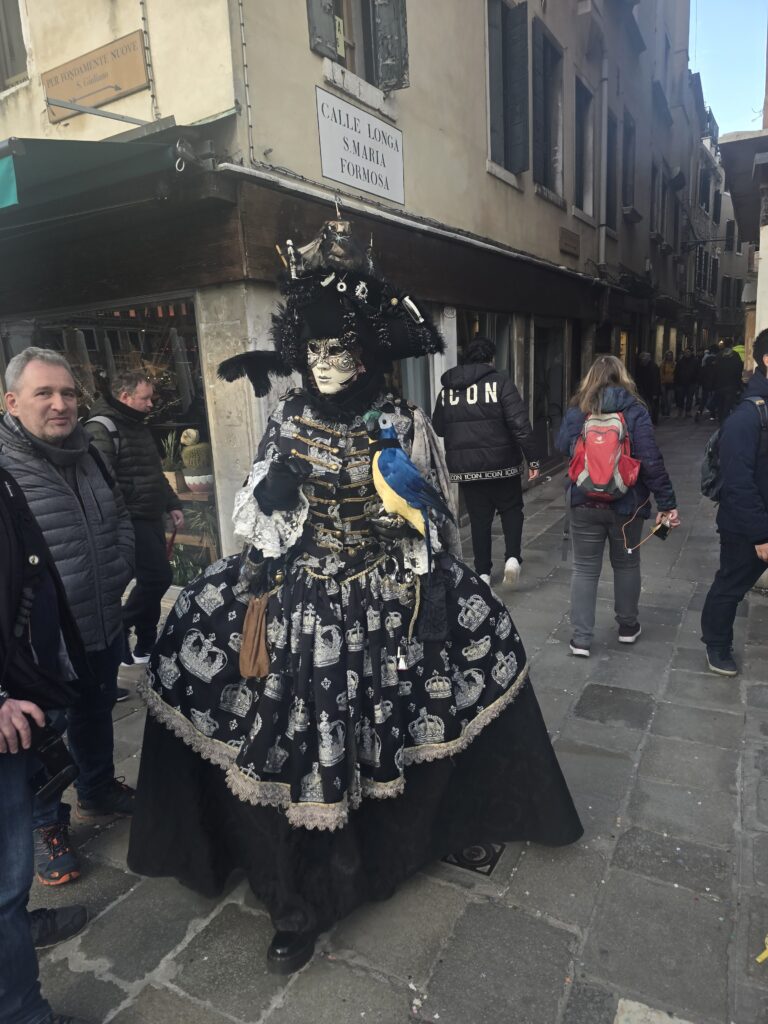
Venice carnival masks and costume. Credit: Daniela Forresu
Beatrice has spent 20 years designing costumes for Carnival; she describes the magnificence of crafting these beautiful garments, using fine fabrics like silk and velvet, adorned with lace and embroidery.
”Every costume, like the mask, is a very important piece of the history of our city. When people wear them, they are not just wearing a dress, but they become part of Venice’s history,” Cardaio explains.

Handmade masks shops in Venice. Credit: Daniela Forresu
Verona carnival: festival of tradition and joy
While Venice is famous for its masked elegance and its costumes, nearby cities like Verona have their own spectacular Carnival traditions. Verona is known for its famous Bacanal del Gnocco- one of the oldest in Italy, dating back to 1531. In this tradition the central figure of this grand parade is Papa’ del gnocco, in the historic district of San Zeno.
He is portrayed as an old man, with a ruddy face and a long white beard, dressed in brown with a red cape and top hat decorated with bells, holding a giant fork with a dumpling. ‘Father Dumpling’, as his name translates, is traditionally elected by the residents of San Zeno.
Verona parade for the bacanal del gnocco. Video credit: Daniela Forresu
This tradition originated during the time of famine, specifically in the 16th century, when the people of Verona suffered from food shortages. To alleviate the hunger, a wealthy citizen organised a distribution of gnocchi for the poor people, and this gesture evolved into a annual celebration.
The last Friday before Lent – known as a Gnocolar – is the most popular day of the festival, when Veronese people gather enjoy plates of gnocchi and celebrate their rich history with joy and music.
Verona and Venice celebrate Carnival in different ways but both of these celebrations reflect the deep cultural heritage and artistic excellence in Italy. Venetian Carnival attracts many visitors into a world of masked elegance and mystery, while in Verona tourists attend Carnival for its Bacanal del gnocco, a food-filled celebration of community and joy.
Italian Carnival remains a testament of history, tradition and festivity. No matter the city, the Carnival spirit invites everyone to embrace its magic and its historical culture.
Leave a Reply