
By Haeli Wilson
Journalism is not an easy field to get into. It’s an even harder field to make a name for yourself in a newsroom – if you aren’t a middle-aged, cis-gender, heterosexual white man.
Breaking into the field is today becoming harder and more difficult. There are many stories from people of colour, including both men and women, who have had to go above and beyond to get a decent job – and then are underpaid, in comparison with their white peers.
It is an experience many go through, with some changing their first names and surnames on their CVs to make them sound “whiter” – and procure an interview.
Obstacles and struggles
Data given from gov.uk shows that 76% of working age people in the entire country were employed in 2022. Of those, 77% were white, while the combined number of others totalled of 69%.
The statistics show a picture. Only 13% of UK journalists are from non-white ethnic groups, according to the NCTJ Diversity in Journalism report, 2022, while newsroom processes ‘continue to be exclusionary and racism is commonplace.’ Black journalists are pigeonholed, face racism and discrimination, and feel there is a lack of support.
Representation of minority communities is weak in UK media, says the Ethical Journalism Network, Structural Racism in UK Newsrooms, 2022, while 80% of UK journalists come from the highest social classes, compared to 42% of the general workforce, says the NCTJ report.
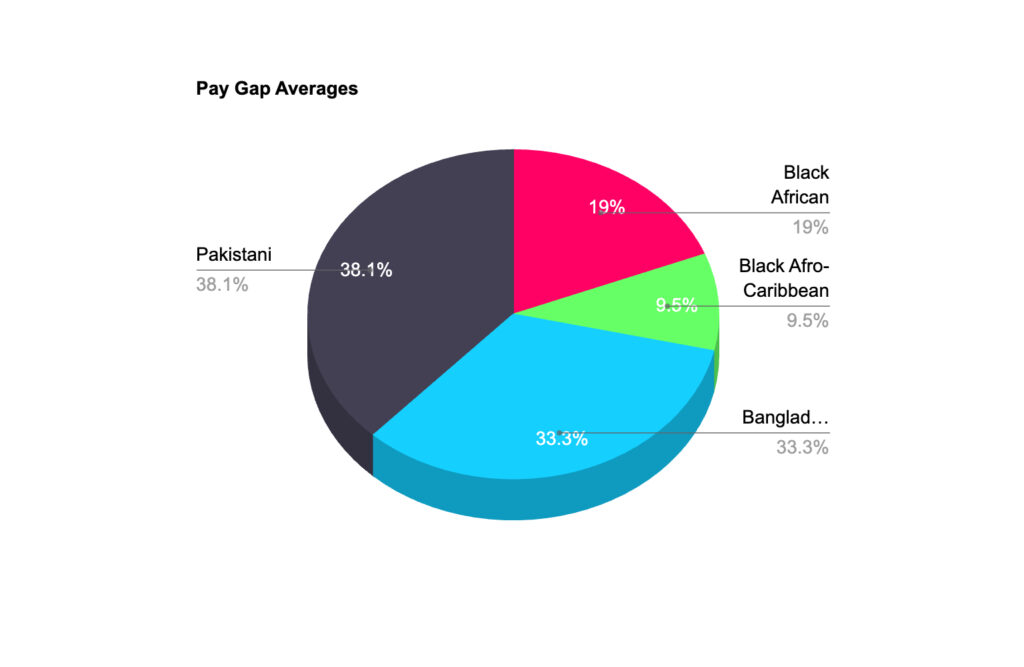
The pay gap is also an issue. “Black African employees earn on average 8% less, Black Afro-Caribbeans 4% less, whilst employees of Bangladeshi or Pakistani heritage earn 14% and 16% less than white employees,” according to the Law Society.
Pay gaps are just one of the many challenges that POC journalists have to face and it has taken exposure from news outlets as well as exposure to the public for some to find out that they have been or are currently being underpaid.
Within many of these challenges and microaggressions, it is women and especially black women who have not been treated right in their workspace. Student Destine Royce who does work for the charity Heritage of London Trust gives her insight on the matter.
“Still experiencing racism or unconscious bias”
Irene Shelley, the Editor-In-Chief of Black Beauty & Hair magazine tells her story about her struggle and what it means being a successful black woman in a mostly white working industry.
“I think those struggles are there to make you stronger. I remember joining a discussion for the British Beauty Council which wanted to poll the opinions of black women working in beauty. We each had a couple of minutes to say what was difficult about our jobs.
“I made the point that in the past I had had very little access to images of women that looked like me and my readers, which had made my job very difficult. There were often times, I would have to drop a story, because I couldn’t illustrate it with the right image.
“The people listening were shocked, as they were white journalists and didn’t have those day-to-day problems. I said that had been my reality, every single day. We didn’t have access to photo libraries back then. We’ve never had mainstream advertisers supporting us; we rely on the smaller brands that work in our market, where there isn’t as much money. I think it was an eye opener for them as well.
“Anyway, many people vented, and it got uncomfortable as there was a lot of pain in people’s stories. One woman ended up in tears, so, we all did too as we all felt her hurt and pain.
“So, I think no matter how included you feel, we are still having to experience racism or unconscious bias. It’s how we choose to deal with it that’s the important.”
Behind closed doors
The killing of George Floyd by policeman Derek Chauvin sparked huge protests around the world, strengthening the Black Lives Matter movement. Many took part in posting black screens on their Instagram pages showing solidarity in the movement itself.
CNN reported on journalists of colour who were fed up, including an article calling out news organization Refinery29 out for the way they treated their black female employees.
A former employee Ashley C. Ford tweeted, “I worked at Refinery29 for less than nine months due to a toxic company culture where white women’s egos ruled the near non-existent editorial processes. One of the founders consistently confused myself and one our full-time front desk associates & pay disparity was atrocious”. Other news outlets that were called out for their behaviour included BuzzFeed, The New York Times, and Variety.
Some organizations in the UK are working to change things. The BBC introduced the Diversity & Inclusion Plan in 2016 to show more representation to their audiences here in the UK as well as globally while also having a more inclusive working environment.
Last year, BBC Radio 5 Live presenter, Nihal Arthanayake, made comments during the Journalism Diversity Fund conference stating that his mental health has been affected from working in such a white environment at the BBC. “It’s really affecting me that I walk in and all I see is white people,” he said.
Room for improvement
The National Council for the Training of Journalists said that there has been progress in not only gender disparity but in employing journalists with disabilities and health issues as well.
“The continuing increase in the number of journalists working in the UK is particularly increasing. It suggests that journalism remains a positive choice for a career in terms of the availability of opportunities and competition for talent,” it said. The BBC has launched the 50:50 The Equality Project to support media organisations around the world to ensure that journalism and media content is fairly represented.
Data from Ofcom shows that between 2020-21 and 2022 the total number of those who are a minority working at the BBC has increased from 13% to 15%. The Sir Lenny Henry Centre has also been commissioned from the organisation with more than £100m for Media Diversity specifically and to also review the three-year diversity commitment that has been put into place.
Underrepresentation is prevalent within the world of news, and a lot of work needs to be done for that to improve. It isn’t just about what we see in person but what goes on behind the scenes as well.
There are news presenters and journalists who deserve more for the work that they are doing. Men and women deserve equal representation which also includes being paid the same for what they all do together.
Leave a Reply