
By Sabrina Aledda
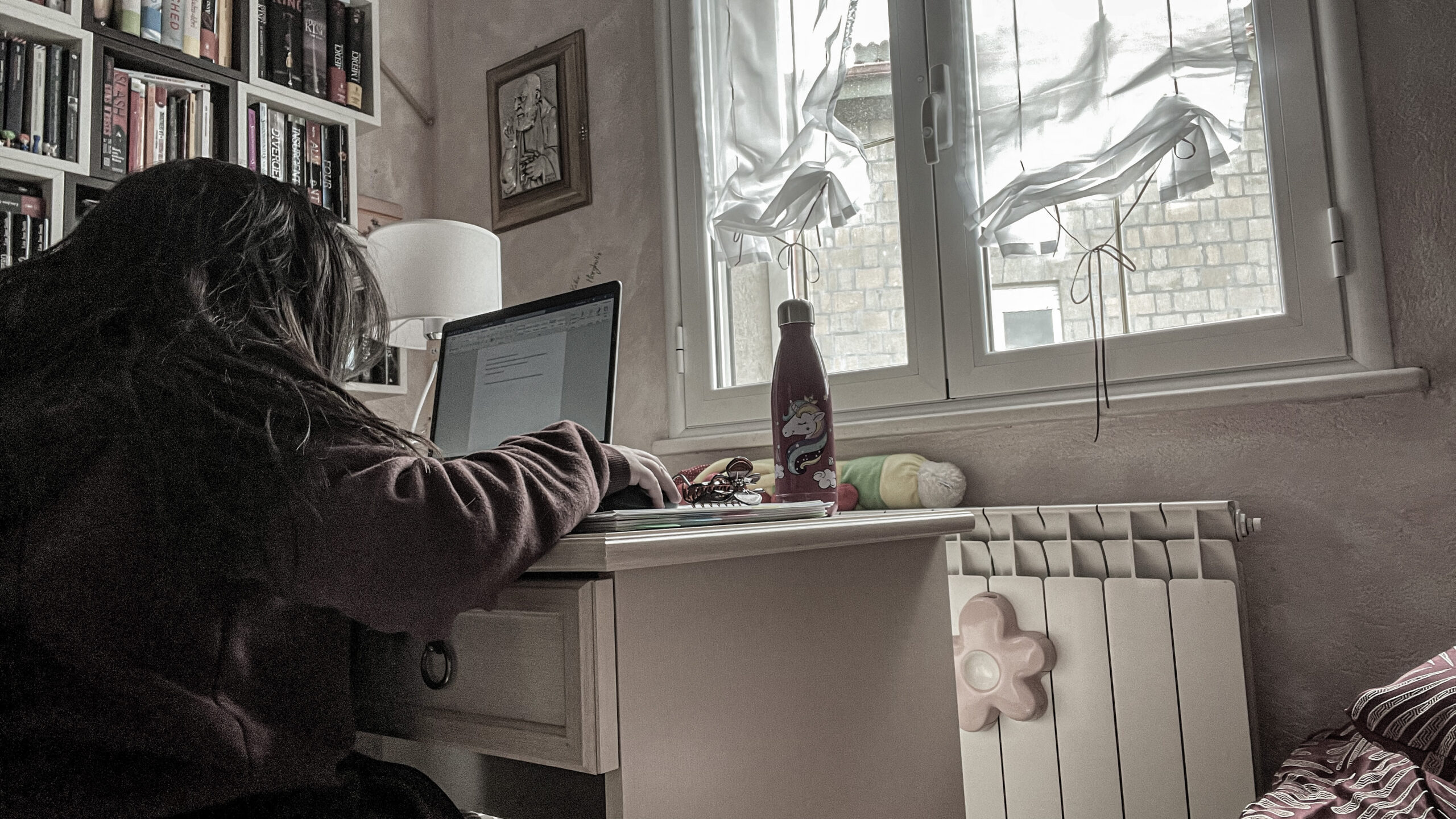
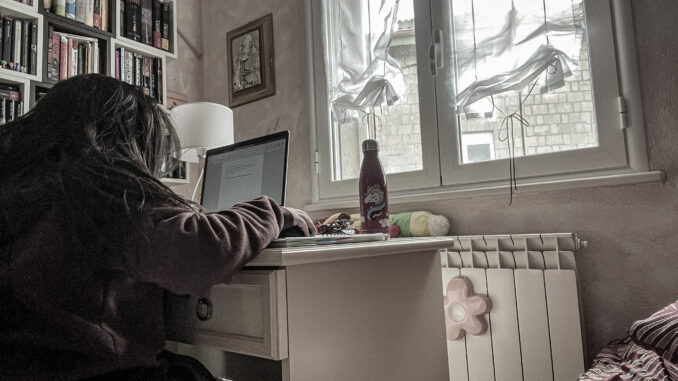
Doing an online lesson. Image: Sabrina Aledda
Both 2020 and now 2021 have been remarkable years for students, as the pandemic has also affected the school sector. All over the world, to limit infections, children have been forced to attend online school, and this has caused a lag in learning and a lot of distress.
Younger children have found themselves having to interact with a screen instead of their companions and friends. Teenagers have faced the last year of high school inside the four walls of their bedroom, in the saddest way possible, losing the chance to make fantastic memories.
In Italy, the education system is very different from the English one, mainly regarding schools aged 12 to 18. Italian children take a diploma in the last year of high school, which is also the country’s year examination. For Italian teenagers, the diploma is one of the most important milestones of adolescence. As they progress, the university system is very complex and, above all, made of continuous examinations and an immense amount of material to be studied.
“I am part of that band of mature students who had to act as guinea pigs for online school and the diploma exam, precisely because it was not yet possible to do it,” says Sara Zucca, 18, who attends secondary school in the Italian city of San Sepolcro.
“At first, it was all a huge question mark, then there was confusion as the professors could not use the digital platform properly as a new tool, and we had to spend the day in front of a screen.”
“Chaotic” exams
She adds that her baccalaureate exam was chaotic, as it was not until the very end that students were made aware of what tests they would take. “I believe, however, that a year after the start of the distance learning, that is still the case,” she adds.
Sara’s cousin Gaia, 22, studies Modern Languages and Translation Studies at the University of Cagliari in Sardinia. “I think I had a different approach to distance learning than what all high school students and students could have. There is no direct contact with those who teach at university, or if there is, it is present in a small part only.”
Other problems were to do with technology, as many households did not have enough computers or sufficient WiFi to cope with both students and parents working from home. Even when the equipment is available, working hours in front of a screen is difficult.
“It is very tiring to stand in front of a screen all day,” said Sara, who said she and her friends had difficulties staying focused in lessons. “Distance learning becomes a great approach if you know how to do it. Otherwise, it remains the classic escape route arranged as best you can.”
Silver lining
But remote learning has also borne some fruit. “I found myself good at taking notes directly to the PC while the teachers explain,” says Gaia. “I can say that I have also gained a greater familiarity with everything related to technology.”
She says she still hope to be able to return to lessons in person soon. “I think that, after this experience, distance learning can remain a valid alternative, or at any rate that mixed teaching can be considered, at least as far as university studies are concerned,” she adds.

A girl struggling in front of her laptop. Photo free by
Leave a Reply