

By Amalie Meland
Climate Crisis is nothing new and it’s just getting worse. Every year billions of tonnes of CO2 are released into the atmosphere, while greenhouse gas emissions produced by human activity are at a record high according to UNEP Emission Gap reports. Extinction Rebellion is an international movement using non-violent civil disobedience in an attempt to make a change.
Marijn van de Geer, 41, has been a part of Extinction Rebellion (XR) since it started in 2018 but has been active in climate and environment campaigning for a long time.
“I think the worst thing you can do now is stay at home and sit on the sofa, just come out and do something, anything,” she said before participating in a panel discussion, Dirty London, as part of London Metropolitan University’s Journalism Newsweek.
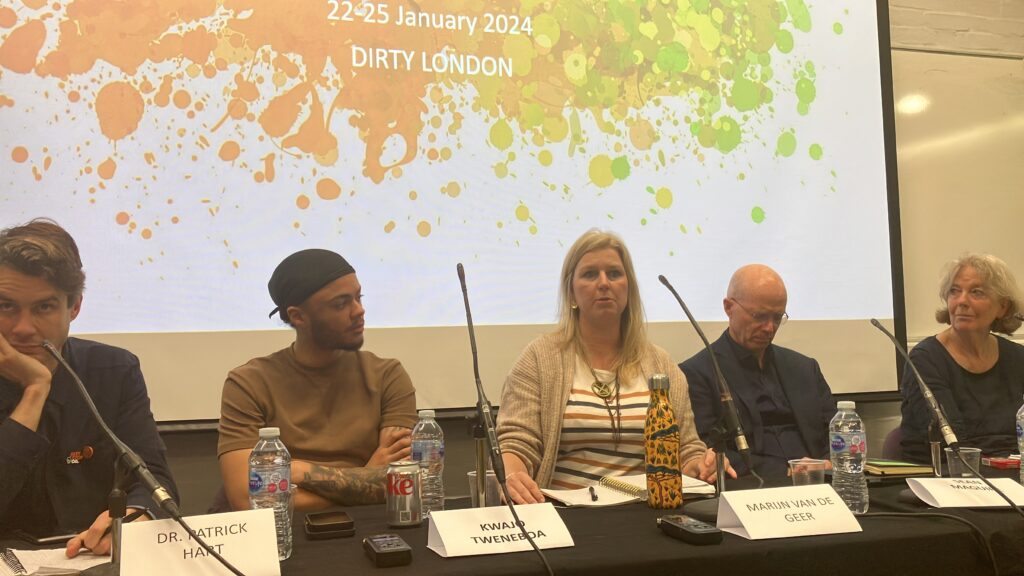
By being a candidate for the Green Party, van de Geer has done all the legitimate routes to try to make a difference.
“I have signed every single petition under the sun, I’ve been on every single protest, and it’s not making a difference. So I was quite excited about this idea of doing civil disobedience,” she said.
Marijn started her career in immigration and refugee organisations, then moved into international development which finally led her to climate and environmental politics and activism after realising that all these issues are all intrinsically intertwined. In 2018 she became a founding member of XR.
In 2019, the group had a five-day coordinated protest at Oxford Circus, intending to bring London to a standstill and force the government into a dilemma.
“One the on hand they didn’t want to give in to us, but on the other hand, it was costing them a lot of money to have London shut down. We really believed that would be the way to get them to the negotiating table.”
Van de Geer was arrested at the protest as were many others, but still thinks about the day with a big smile on her face. “I would do it all again, in a heartbeat.”
In 2023, the group decided to abandon disruptive action because of the criticism they got. Many people agree with what they stand for but not the way they were doing it, according to van de Geer.
“They don’t like that we are disrupting ordinary people trying to get to work or trying to get to the hospital or whatever. So we are going a year without blocking roads/tubes/buses and see what happens.”
As a result, in the first few months alone, a lot of people joined the movement who had previously felt that they couldn’t join because of the way they disrupted ordinary people. The group is still sticking to this tactic but has since decided to do direct actions, but very targeted.
“We will be targeting the fossil fuel industry and everything that is connected with that, we will target the industries that are destroying the planet.”
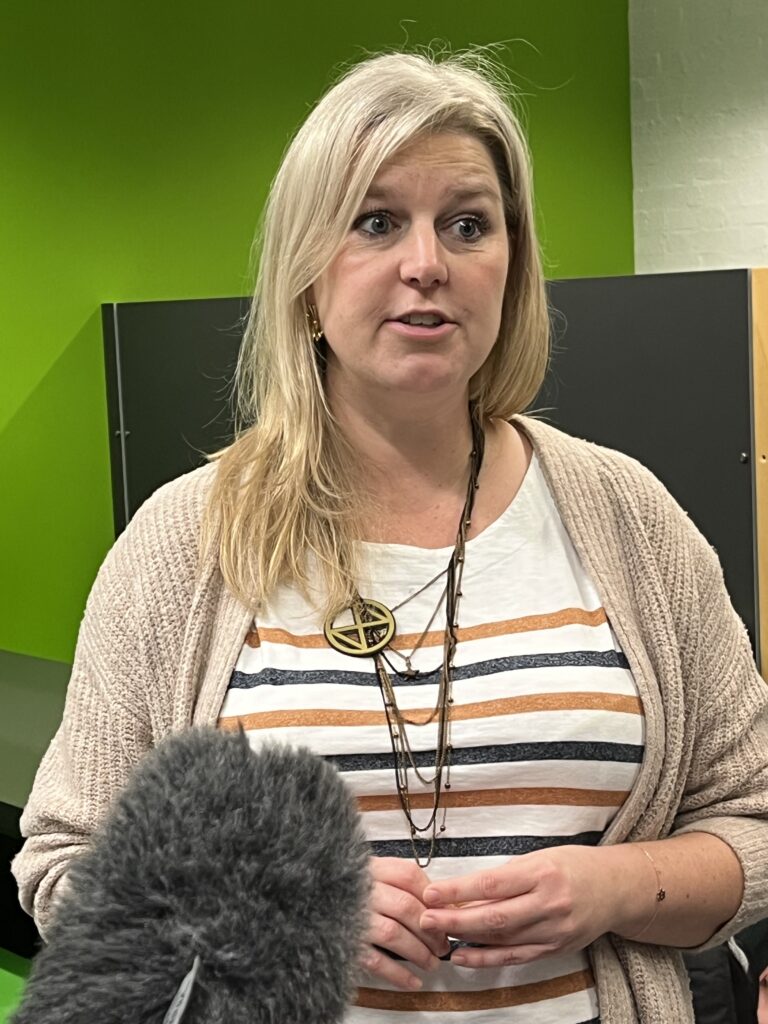
Photo by Wendy Sloane
The question now is if this tactic is less effective. In April 2023, Extinction Rebellion organised a protest In Westminster where 100,000 people showed up, but it didn’t make any headlines. Many journalists were wondering if they were going to disrupt the London Marathon, which took place on the same weekend, but they didn’t.
“I really believe that if we had disrupted the London Marathon, we would have been on the front page,” she says.
Van de Geer gave another example about how disruptive protests get more media cover. A few days before their protest, someone from the activist movement Just Stop Oil went to a Snooker World Cup final, covering tables in their signature orange powder. The event made many newspapers’ front pages.
“That was one person, and we had 100,000 people not causing disruption,” she says.
The government has to take action to tackle the climate crisis. The first demand of Extinction Rebellion is telling the truth, van de Geer says.
“We think what the government needs to start with first and foremost saying it how it is, no more beating around the bush. The people of this country deserve to know the truth and how bad it is, but not in a way that overwhelms, ´like wow´, but to say ´here is the plan´ so people understand we need to take urgent action.”
Their second demand is to act now. Their initial demand was net-zero emissions by 2025, that is already next year, and science is showing that this is what should have been done, according to van de Geer.
“We have to be true to what science is telling us, whether we can do it or not is not the point. We have to tell people that this is what we should be doing. So, no kicking the can down the lane, no 2050 targets, 2050 is obviously ridiculous, it’s far too late.”
Their third demand is the Citizen’s Assembly, which is a group of randomly selected people sorted into an assembly that reflects society as a whole. They will get all the information, all the solutions, all the problems, all the different aspects, stories from people that are already dealing with climate and ecological breakdown, how it’s affecting them and that sort of thing, van de Geer says.
“And that will also be quite fast, if the government were to commission this assembly tomorrow, we could potentially have results in nine months’ time.”
Leave a Reply