
By Antonia Copsas-White
With the latest release of the Epstein files, millionaire financier Jeffrey Epstein’s connections and influence over major players in the fashion and modelling industry has become undeniable. But how has this influenced today’s body standards for women in the fashion world, if at all?
Epstein, a financier and convicted sex trafficker who was known for his interested in underage girls, kept modelling agencies and scouts close. Through them he was able to procure women and girls to entertain himself and his clients, by promising lucrative modelling contracts.
Some of the most high-profile people he worked with in the modelling world, whose work had influence over thousands of young women and girls, were closely connected to him.
They included Jean-Luc Brunel, a French model scout who Epstein financed to open his Miami-based agency, MC2. Epstein victim Virginia Roberts Giuffre, alleged in court filings that “teenage girls brought to the US by Brunel on model visas were ‘farmed out’ by him to Epstein and others for sex”, the Guardian reported. Before killing himself in prison in 2022, Brunel denied all allegations.
Daniel Siad, another associate of Epstein’s, was also a model scout he allegedly kept close. The Guardian reported Siad having emailed Epstein: “I had 2 girls from Sweden, a Slovakian, 2 French and [redacted] the Russian, with whom you spoke and a beautiful Chinese named [redacted]”.
He was also known to scout in Scandinavia with The Guardian saying: “He was happy to report that a recent trip to Scandinavia had been very productive: at least five of the girls he had met were just 16 or 17, and there was a 15-year-old girl from France whose parents were happy for her to start modeling.”
In addition, Epstein helped finance opportunities at brands such as Victoria’s Secret – in fact, US billionaire and former Victoria’s Secret CEO Les Wexner hired Epstein as his financial manager from 1987-2007. He also promised young women he was grooming or had a relationship with admission into Ivy League universities, including Columbia University.
According to the released files, many of the email correspondents to Epstein regarding these girls make mention of their ‘skinny’ bodies; an email from an unknown sender read: “I found a new friend for you [redacted] French, lawyer, skinny tall, will send pics.”
Another email from his girlfriend, Karyna Shuliak, contained a link to a video on YouPorn titled, “Two Skinny Babes Get F****d by Lucky Guy”. An annotated, revised copy of the novel Lolita by Vladimir Nabokov, which chronicles a grown man’s sexual infatuation with a pre-teen girl, was also found in his Amazon buying history. Additionally, Virginia Giuffre made mention in her memoir Nobody’s Girl that Epstein would closely monitor and manage girls’ diets to maintain their teenage and prepubescent bodies.
But how does this link back to today? The standard throughout the ’80s, ’90s and ’00s focused on very thin and arguably under-developed women; hairless, narrow shoulders and hips, small breasts and bottoms, doe eyed.
In the 2010s, headway was made in including more realistic women, the beauty standard shifting towards curves. Celebrities such as Kim Kardashian perpetuated this by getting features such as her breasts and rear surgically enhanced in invasive procedures. Other trends, such as “gym girl”, focused on training and ascertaining these features naturally and equally many chose to embrace their body hair.
Since the 2020s, however, things seem to have shifted. Trends tend to operate on a 20-year cycle, so the rise of 2000s fashion seems natural, but does this extend to 2000s bodies as well?
If the models walking the cat walks and modeling the clothes fit into this uber-slim, hairless and underdeveloped look are being scouted by men and companies linked to child sex trafficking, then it can be argued they are responsible for generations of young men and women expecting this standard of themselves and their female counterparts.
Model Kate Moss, who allegedly mingled in circles curated by these men, is quoted as saying ‘nothing tastes as good as skinny feels’. This quote is seeing a resurgence on social media platform’s such as TikTok today. During lockdown, a sharp rise of young girls developing eating disorders was observed.
TV shows such as America’s Next Top Model have seen a resurgence in the 2020’s, with Netflix’s new documentary, Reality Check: Inside America’s Next Top Model, exposing the reality of the standards these girls were held to.
Additionally in the 2020s, the annual Victoria’s Secret Fashion Show has seen a resurgence, though not televised but rather streamed on Amazon Prime. The show was originally cancelled partially due to Wexner’s association with Epstein, leading to a drop in viewership. On October 15 2024, the show returned, hosted by Tyra Banks.
Notably, the recent shows have made a point of casting older and plus size models in an attempt to shed their questionable image of the past. While it’s still progress, many of the plus size models have faced harassment, bullying and body shaming online from viewers and the show has been accused of tokenism and performative diversity by members of the public. This shows a rise in the preference of slimmer bodies making a comeback.
Through social media platforms such as TikTok, Instagram and Pinterest, artists like Lana Del Rey and Sabrina Carpenter dominating TikTok trending sounds, and influencers like Nara Smith gaining popularity, the “coquette”, “Lolita” and “trad-wife” aesthetics have seen their peak among younger women and girls.
The main focus of these trends include clothing such as Mary-Jane shoes, bows, Peter-Pan collars and baby-doll dresses taking over. There’s also a focus on traditional gender roles such as homemaking for women, breadwinning for men and the idea of submitting to your husband.
Sabrina Carpenter sparked controversy last summer with the release of the cover and title of her latest album: Man’s Best Friend. Not only does the title alone provoke a reaction, but the cover itself features her on her hands and knees at the feet of a man whose hands are pulling her head up by her hair.
Additionally, popular social media influencers such as Andrew Tate and Clavicular push the narrative of women being ‘past their prime’ when past their early 20s, furthering this idea into young people’s beliefs systems.
On the other hand, Y2K clothing has been seeing another resurgence on social media. This includes clothing items such as low rise jeans, micro-skirts and baby tees, reminiscent of something Paris Hilton may have sported 25 years ago. Traditionally, this clothing style has been primarily worn by thinner bodies, though there’s been a push on social media for more diverse body types to embrace the style.
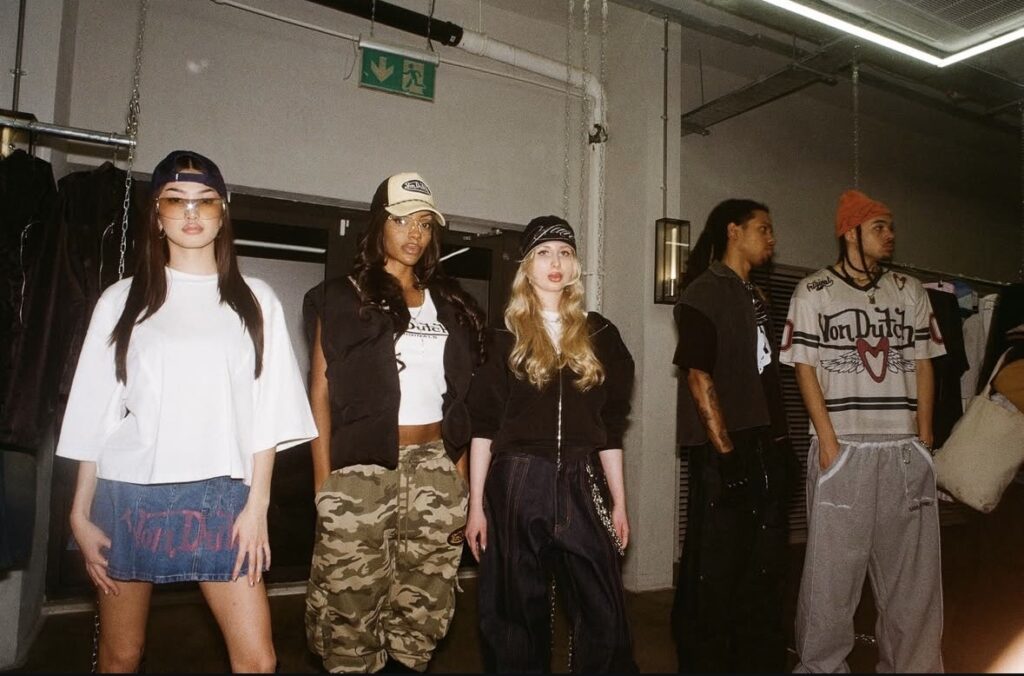
To get a better, industry perspective on the matter, Santi (@santixsanchex on Instagram) a stylist for Unsung Agency, gives his perspective on these fashion trends making a resurgence.
Do you think trends are pushed through brands, shows and marketing still or do they come from social media now?
I think brands are at the forefront of pushing trends by different marketing strategies, like product placement on celebrities, that’s what people get most inspired by. People get inspired or try to copy celebrities not fashion houses.
So do you think people exclusively copy celebrities or do influencers count too? Would you group the two together?
I mean, influencers are celebrities.
Do you think current fashion trends contribute to the infantilisation or objectification of women, or are they worn in a reclamation of power sense?
I think it depends on the brand and their outlook. Some brands definitely rely on shock value and I think that can come with a lot of taboo topics or edge on uncomfortable. We see patterns of no body hair, only young female models or clothes reminiscent of kids’ fashion. It’s also astonishing the lack of women in the role of head of creatives in fashion. I would say it’s not empowering since its pushes body standards that are not real or healthy.
From your perspective as a stylist, why do you think super-slim, ‘heroin chic’, bodies cycle back as the dominant fashion trend?
I think it all comes down to the political spectrum we find ourselves swinging back and forth for decades. I think the world a few years ago went full left and liberal and that makes the pendulum swing back back to full blown conservative standards. With that the body image standards, recycling old ideas and creating ‘nostalgia bait’ for people that want to live like past decades without any of the substance in any of those subcultures, like the 2000s NY party scene that the current ‘heroin chic’ is trying to recreate.
Do you think the fashion industry is shaping the current demand for thinness or just responding to it?
I think it’s a symbiotic relationship, they feed each other. Fashion and culture push for a look and people get obsessive over it. Everyone else then tries to replicate it and it just becomes a trend.
At London Fashion Week 2026, trends that fit the “coquette” aesthetic (i.e. bows, Peter Pan collars, baby doll silhouettes) appeared on the runway in many collections. Do these details contribute to a broader infantilisation of women and women’s fashion? Does the casting of ultra thin bodies reinforce the childlike visual language of these designs?
The coquette aesthetic is rooted in cultural references such as the novel Lolita by Vladimir Nabokov. It is an ode for pedophilia and creating this weird visual language of “innocence” through clothing and how women should be perceived as such.
Do certain silhouettes (i.e. micro skirts, baby tees, low rise fit, oversized collars) function differently when worn by very thin bodies as opposed to more diverse body types?
I think fashion has always appealed to skinnier bodies, fashion is not for everyone, as much as fashion houses would like you to believe. They always try to push a look in high fashion that has a certain body standard and look, clothes get made with a client in mind, in every aspect, looks wise, status wise or the illusion of it.
So where does that leave us now?
It is undeniable that for decades, Epstein’s and his associates’ idea of beauty for women and girls has largely shaped the world view on the topic.
Generations of women are grappling with the fact that their self esteem was directly linked to child predators’ ideas of beauty, as Instagram creator Ileana Justine mentioned in a reel: “Right now millennial women are forced to reckon with the fact that our experience with girlhood was directly tied to the most powerful sexual predators. Millennial women grew up in the shadow of Jeffrey Epstein. We didn’t know it at the time but he and his pedophile friends had a finger on all of our decisions… It’s not just that the people we held up as heroes; princes, presidents, hollywood stars—were in fact villains. It’s that the power they wielded over society impacted all of us. The perverted nature of these men infiltrated every aspect of our lives.”
As we circle back to trends from 20 years ago once again, it is important we leave certain aspects of them where they belong: in the past. We must continue the conversation of questioning the need we feel for our bodies to conform, as discussed in this essay by Fan Girl Digital on Substack.
When feeling the pressure to comply to these trends and standards, it is imperative to remind ourselves where they come from and who set them.
Leave a Reply