

By Hannah De Haro
Photo by Hannah De Haro
For years, a university degree was seen as a clear pathway into employment. But for many graduates in London today, that pathway is starting to feel uncertain.
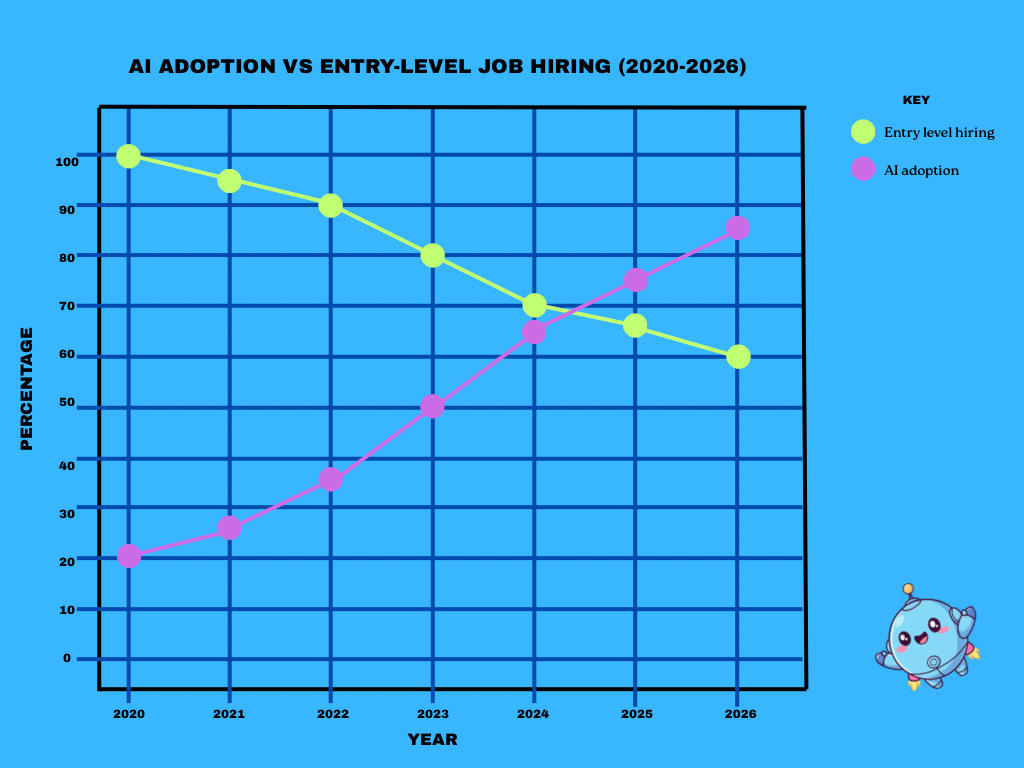
With the rapid rise of artificial intelligence tools, entry-level roles, once the first step on the career ladder, are beginning to change, shrink and even disappear altogether.

Industries that traditionally relied on junior staff, such as marketing, administration, and customer service, are increasingly turning to automation. Tasks like writing emails, analysing data, and even creating content can now be handled by AI in seconds.
In business districts like Canary Wharf, where global companies operate at scale, efficiency is key, and AI is quickly becoming part of that equation.
But what does this mean for graduates trying to enter the workforce?
This concern is echoed across London, where competition for roles is already high. For some, the fear isn’t just unemployment, it’s being replaced before they’ve even started.
Maximilian Polanski, 21, a student, reflects this uncertainty: “Securing a job after graduation is already stressful but now with the involvement of AI, I think it might be harder,” he said.
Despite this, he remains cautiously optimistic, adding, “I do think uni is still worth it, for the experience but also because I don’t think AI will fully take over the workforce. I think human employees are still very valuable.”
However, he admits to mixed feelings about the technology, saying, “I am not a fan of AI so I try to stay away from using it as much as possible, but I have used it in the past to help with my work.”
Others feel more secure, depending on their chosen career path. Lauren Redmond, 20, who is training to become a nurse, believes her future role is less at risk. “I am studying to become a nurse so surely AI won’t be able to replace my future job, it would be worrying if it did.”
She adds, “Since my future job is quite hands on I am not worried about job security, but I can understand how other jobs may feel at risk.” Unlike many students, she has chosen not to engage with AI tools, explaining: “I have never used AI to assist my work before, it wouldn’t feel right.”
However, the rise of AI is not entirely negative. While some roles are being reduced, others are evolving. New opportunities are emerging in fields like AI management, prompt engineering, and digital strategy which are roles that didn’t exist just a few years ago.
Adaptability is now more important than ever. Graduates are being encouraged to develop skills that AI cannot easily replicate, such as creativity and critical thinking.
Still, the transition is not without challenges.
Leave a Reply