

The future looks cash-free and the pandemic hastened closures of cash machines around London. Reporter Carolina Piras explores the impact of the Coronavirus on the decline of cash usage, featuring an exclusive interview from financial journalist Jasmine Birtles.
By Carolina Piras
A cashless society is a new frontier. Card machines, contactless payments, cryptocurrencies, and even under-skin microchips make it look like cash is destined to disappear.
The pandemic speeded up the process, but the UK saw a high decrease in the number of ATMs on the streets a long time before Covid.
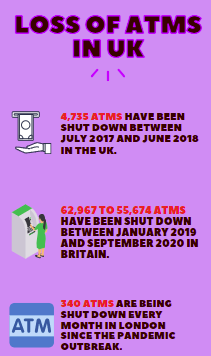
A study by card machine provider Paymentsense reveals that over 4,735 ATMs were shut down between July 2017 and June 2018.
And the restrictions imposed due to the global pandemic have hastened cash machines’ closures.
You might have noticed that something else has changed too. Think about the last time you withdrew cash from an ATM. Yes, the cash machine right behind your house now probably charges you at least £ 0.99/£ 1 to get your money.
For many, this is progress but for others going cashless is a real fear.
How many ATMs have we lost?
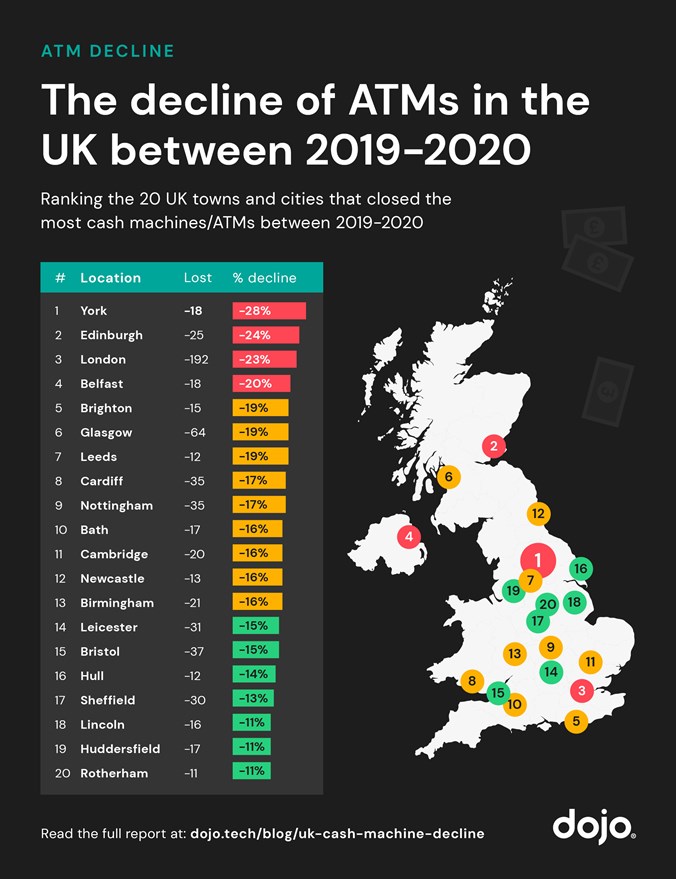
A recent report by Dojo, a UK merchant payment provider that is part of the Paymentsense brand, puts a spotlight on Britain’s drastic loss of ATMs, telling which UK cities have been most affected.

London has lost almost a quarter of its ATMs only in the past year, precisely 192 cash machines. This means we now only have 638 ATMs in the city, with a population of almost 9.5 million people. To put it simply: one machine is now serving 14,583 people.
Jon Knott, Head of Customer Insight at Dojo, said: “During the coronavirus pandemic, the makeup of the great British high street has changed enormously. While it’s long been evolving in the face of the rising of the digital marketplace, coronavirus has reaffirmed the dominance of financial technologies.
“It is no surprise then, in our digitised economy, that the use of cash is decreasing, making ATMs redundant.”
According to Link, the largest network of ATMs in the UK, the number of cash machines in Britain has substantially dropped, from 62,967 to 55,674 between January 2019 and September 2020, with a deviation of 7,293 machines.
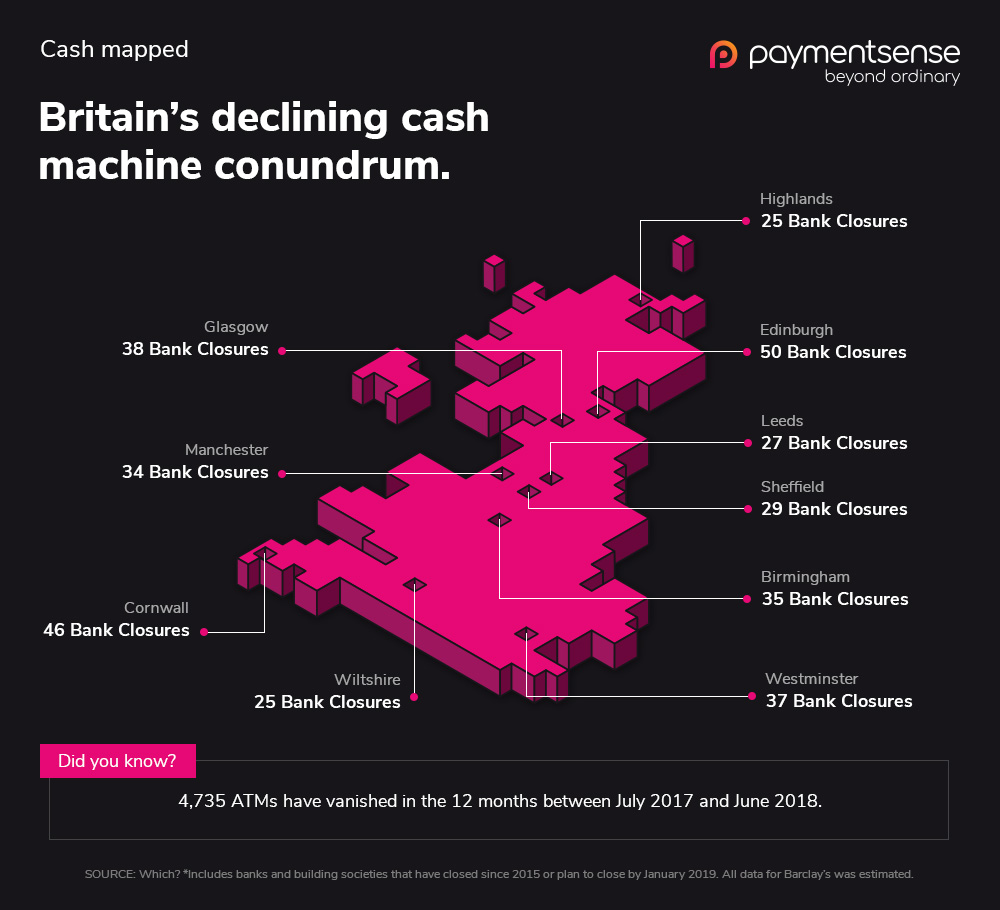
The city of London is now witnessing the shutdown of over 340 ATMs every month since the pandemic’s outbreak.
Why are free-to-use ATMs declining at a faster rate than those that charge?
Another interesting phenomenon has increased during the pandemic: free-to-use ATMs are dropping at a faster rate than those which charge a withdrawal fee.
Why? These machines, which are less financially viable, have been the first ones to disappear through the pandemic. This fact presents two issues. First, the people are left with less choice of where to go to take out their money. Second, it affects the elderly and those on low incomes as they are the most reliant consumers on ATMs.
‘Fight for your cash!’
Jasmine Birtles, TV presenter, author, and founder of MoneyMagpie spoke about society going cashless in an exclusive interview for Holloway Express.
Birtles, from Kensington, expressed her “deep concern” on the loss of cash as well as ATMs. The 45-year-old, who is also a financial journalist, has previously written about the situation, stressing why we should fight for our cash.
“I think the convenience of paying by card has eroded our interest in using cash. It’s also much more convenient and easy for businesses to deal with card transactions than cash ones,” she said.
The MoneyMagpie founder advised that those who would be affected by a cashless society are the most vulnerable as well as the elderly. “Many jobs still pay in cash and there are hundreds of thousands of people who don’t even have a bank account in this country,” she adds.

Birtles also remarks that young people – millennials and GenZers – seem to “have no problem with others – government, Big Tech- knowing everything about them.
“Had the Third Reich or Stalin’s Russia had the technological capability that we have now, they could have destroyed the world, not just their little piece of it,” she claims.
The TV presenter looks at the end of cash as an actual “threat to our democracy” that would only create a “society of ‘serfs’ –you and I- who own nothing, have no rights and no knowledge”.
But, the world would see a few individuals and organisations – mainly Tech Giants – knowing everything about us and owing everything “forcing us to rent from them at their rates”.
Digital cards can trace money
One of the arguments to support a cashless society is the fact that digital cards can trace the money, which would force illegal businesses to shut down sooner or later.
Erfan Parizi, 23, day trader and financial analyst, says he agrees on some benefits of the cashless society but also sees its risks in long term.
“By tracing the money, the grey economy would be discouraged. For example, if you deal drugs, you will have to stick to cash and you will end up with a bag full of money made from cocaine, but you can’t use it in any way.”
Parizi emphasises the importance of ending money laundry, saying that there will be less as there will always be a paper trail.
“But I have to admit I’ve seen personally the big loss of ATMs. Recently, I needed to withdraw some cash and only one of the 5 cash machines in the area worked.
“There is also a great enjoy traveling internationally with easier currency exchanges,” he adds.
But Jasmine Birtles argues that even though criminals love cash “the element of control is irresistible to them”.
“Look at China – the biggest digital dictatorship in the world – they have produced their digital currency which gives them even more control over their populace. Our Government wants to do the same. Horrendous!”
She corroborates the theory that criminals will always find a way to challenge the rules. “Simply getting rid of cash won’t stop them,” she states.
“They will use cryptocurrencies and might even create their special ones. They have the money and the clout to hire clever developers to set something up for themselves. They will always be all right!”
Birtles points out another reason of concern. “The only complaints I see are the ones about access to cash for people who are not internet-savvy. I rarely hear anyone talk about the threat to democracy and personal freedoms. Occasionally one hears about the vulnerability of digital money in the case of a cyber-attack but not much more.”
Leave a Reply