
By Anastasiia Savina
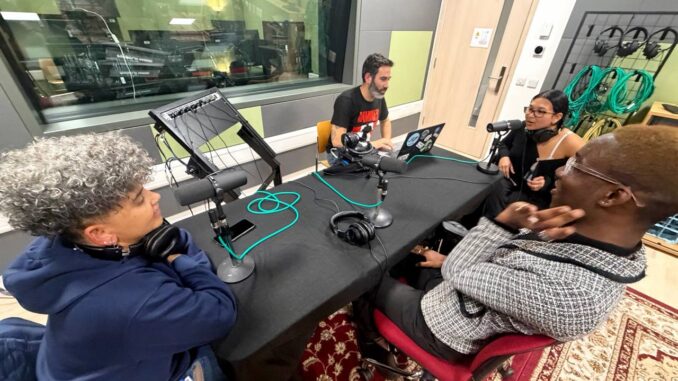
Daisy De Lima Almeida, Federico Paz, Rebeca Roberts, and Jasmine Joseph recording the podcast. Photo by Anastasiia Savina
Students at London Metropolitan University gathered to record a podcast discussing how artificial intelligence is currently shaping creativity, particularly within the fashion industry. The conversation brought together different perspectives, exploring whether AI is enhancing creative processes or challenging the role of human originality.
Students recording and discussing the podcast on AI and fashion. Video by Anastasiia Savina
The discussion quickly revealed that AI is no longer a distant concept, but a present reality in fashion. From styling to content production, technology is becoming deeply embedded in the way creative work is developed and shared.
Kenzo Domingo, a Fashion Marketing and Journalism student, described its impact as significant.
“AI has had a very, very big effect on the fashion industry,” he said. “From styling to modelling to content creation, it has become very integrated in the fashion community.”
While this integration makes processes faster and more accessible, it also raises concerns about originality. If anyone can generate fashion ideas instantly, what happens to individuality?
Students repeatedly returned to the idea that creativity cannot be programmed.
“You can’t necessarily teach creativity,” Kenzo explained. “You can’t expect AI to think outside the box when it’s a programme.”
This perspective reflects a broader concern within creative industries. While AI can generate visuals or assist with ideas, it is ultimately based on existing data – meaning it reproduces rather than truly creates.
Not just about the visuals
Participants in the podcast emphasised that fashion is not only about visual output, but also about the process behind it.
“You won’t get the feeling that it was actually created by someone,” one student said. “The whole process matters.”
This idea connects closely to how designers develop their work. Fashion often draws from personal experience, culture, and emotion – elements that are difficult to replicate through algorithms.
“You can’t input an experience into AI and expect the same human result,” another participant noted.
The conversation also highlighted how fashion, like music, is rooted in storytelling. Designers create not just clothing, but narratives influenced by their background and environment.
“You can see the design, but you also feel it,” one student said. “That can only come from a person.”
Practical benefits
Despite these concerns, students acknowledged the practical benefits of AI. It was described as efficient, accessible, and useful for handling repetitive tasks.
“AI is very time-efficient… anyone can use it,” Kenzo said.
This efficiency suggests that AI may become a valuable tool rather than a replacement. It can support production and idea development, allowing creatives to focus more on concept and identity.
At the same time, the discussion made a clear distinction between technical processes and creative thinking.
“When it comes to mass production, AI could replace us,” Kenzo admitted. “But when it comes to the early stages of creativity… I think that will be left to us.”
The podcast ultimately presents a balanced view. AI is not simply a threat, but it is also not a complete solution. Instead, it is a tool that is reshaping the boundaries of creativity.
As the fashion industry continues to evolve, the challenge will be maintaining individuality in an increasingly automated world.
AI may be able to generate ideas – but for now, meaning still belongs to people.
Leave a Reply