

By India Gustin and Rose Blanchard
Last night’s panel discussion was all about sustainability. Fashion Reborn: Reuse and Rethink encouraged students to think about pressing issues such as whether we will ever be truly sustainable, ethics and the conflict in Ukraine.
The panel was made up of speakers with experience in the sustainable fashion field, from lecturers to journalists and activists. They included Delphine Chui, Caroline Ash, Ross Pollard, Tina Charisma and Brooke Roberts-Islam.
16:55 Panellists have arrived and are ready to start the fashion event — Fashion Reborn: Reuse and Rethink
16:59 Course Leader, Wendy Sloane, introduces the panellists to the audience. Introduces Gillian Wood as the facilitator
17:06 The two student films which won the competition about showing how to make use of staple wardrobe items are shown. India Gustin and Emily Boon are the winners
17:11 Introduction of Gill congratulating the winners of the video competition. “Sustainability has been and continues to be a hot topic. The fashion industry is one of the world’s largest polluters.”
17:13 “Can fast fashion, ever be sustainable? How can we all re-think and reuse our clothing to keep our world safe?” Gill introduces the panelists: Delphine Chui, Caroline Ash, Ross Pollard, Tina Charisma, Brooke Roberts-Islam
17:19 Students start asking their questions to the panel members
17:19 Oana Orzac asks the entire panel: “What can the government in the poorest countries do to help prevent exploitation of women in producing clothes in the fashion industry?”
17:20 Brooke: “This is a tremendous question.” She discusses the concept of power play among factories to make sure they produce as cheaply as possible. “A perfect storm is created.” She is adamant that the solution lies within changing the model
17:24 Tina discusses her take from Ghana. “I can only speak on local community level.” She talks about challenging our perceptions of quality in our era and doing our homework to find these sustainable brands
17:28 Ross talks about his past working for “two big bads.” He discusses how this helps to separate which brands we should and shouldn’t be looking at

17:32 Caroline talks about how these things have been going on for years and everyone knows about it. “Probably in a five mile radius of here, there are people being worked like slaves.” She adds that the fault is also from the big customers pressuring factories for lower prices. “Everybody is at fault. We have still got so much further to go.” She proposes to boycott the companies who have bad practices
17:35 Delphine answers the question from the point of view of a consumer and journalist. “Transparency is really important.” She says that every purchase is decisive in our sustainable fashion future
17:36 Student Weronika Maleszewska asks: “What is the difference between sustainable and ethical fashion?”
17:37 Delphine starts off by saying: “Sustainability is such a huge buzzword”
17:38 Caroline agrees with Delphine but adds that sustainability and ethics go hand in hand. “They are inexplicably linked.”
17:40 Ross: “Absolutely, the two must go hand in hand.” He believes that greenwashing comes from how companies think that they can advertise solely on what the fabric is made from rather than worker conditions
17:41 Tina says there isn’t much she can add to that but says that we have to remember that there are genuine brands out there who do what they say they’re doing
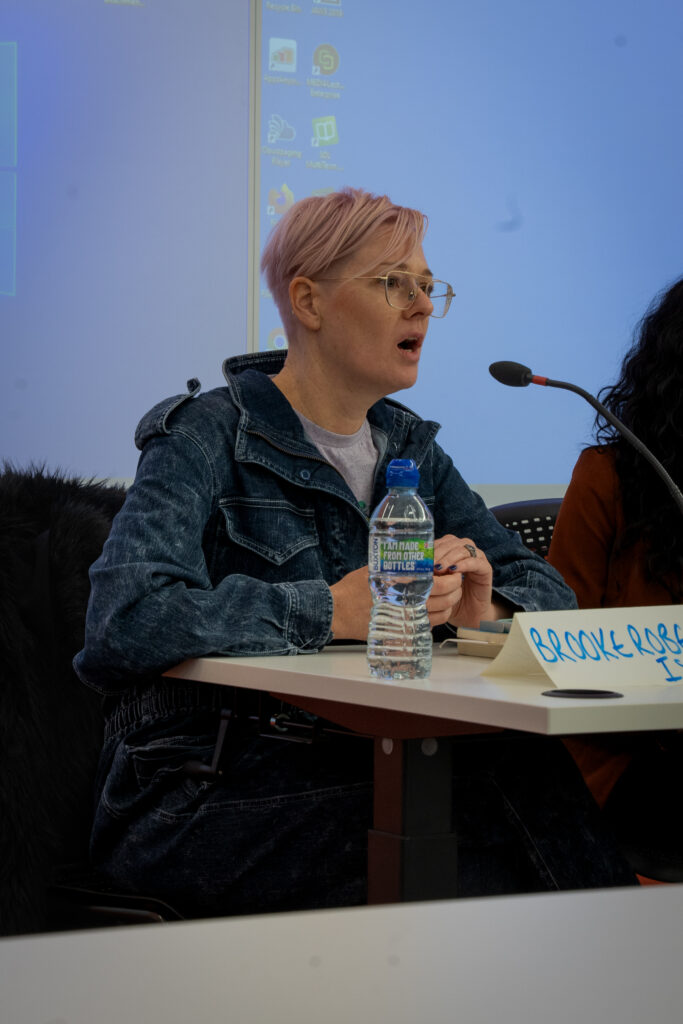
17:42 Brooke: “It’s a confusing area.” She explains that in the past, when CSR was born, ethics came into play. She believes that the problem is that sustainability and ethics never had a framework to distinguish them formally. She concludes by saying that it continues to confuse us and that the industry needs better tools to measure them
17:46 Student Francesco Fiori asks: “What do you think about social media, which encourages people to buy more and more with every changing fashion trend, and doesn’t encourage sustainability?”
17:47 Delphine points out that influencers have a big responsibility when it comes to showcasing what they are wearing. She also says that we could possibly trick the algorithm into stop showing us fast fashion adverts.
17:48 Student Gwladys Beya asks: “How can you convince people on a limited income to not buy fast fashion? How can students keep up with trends?”
17:49 Tina: “Wear your mum’s wardrobe.” She agrees that there are sustainable brands which are expensive. “It’s a gradual process, and that is ok. There is a big difference between being conscious and not understanding the purpose of it. Sustainability is a trend.”
17:52 Brooke disagrees with Tina saying that sustainability isn’t a trend. She believes that marketers make it seem like it is a trend when it’s not.
17:54 Student Megan Morgan asks: “How can we get rid of the stigma/snobbery of charity shopping?”
17:54 Ross: “I am wearing a charity outfit right now.” He recalls his childhood of receiving a lot of hand-me-downs from his brother because of his working class roots. “It’s about doing what you want and following your own morals. Flaunt it, push it, love it and don’t worry about the responses of people around.”
17:56 Caroline agrees and believes that we do need to be proud of it
17:57 Student Nathan Cortes Roja asks: “Will sustainable fashion decline or become harder to produce because of the Russia-Ukraine crisis? And due to the airspace bans imposed because of the conflict, will sustainable fashion get a boost? How has the war in Ukraine affected buying and receiving products from abroad – what are the implications for the future?”
17:57 Caroline isn’t sure on how to answer this question, saying that she doesn’t know what is going to happen. “We can make sustainable, here in London.”
18:01 Brooke adds on, saying that it is important to look at trade routes and seeing whether they pass over Baltic routes. She says that they don’t and that they can easily bi-pass them

18:02 Delphine thinks that what is happening in Ukraine is going to be purposeful for the future in making our consuming choices more intentional
18:03 Gill adds to the question, asking about how the bigger brands are stopping trades in Russia. Passes onto Ross
18:03 Ross is concerned about the young people in Russia and how the war will impact their future. “These companies will just flow back in.”
18:05 Student Katie Woolgar Brown asks Brooke: “How can the development of technology help sustainability in the fashion industry?”
18:05 Brooke begins by saying that technology allows us to do incredible things, being an extra layer on how we assess the environment around us. “Sustainability is not binary.” There is no technology without science. “Human action is the final step,” not technology and science.
18:08 Student Claire Shaw asks a question to the whole panel: “Do you feel that fashion businesses are truly being held to account now, and that real change is happening as a result of these global conversations?”
18:08 Caroline: “No, they’re not being held into account enough.” She believes that the more pressure is put on brands, the better.
18:10 Delphine: As a journalist, “it’s important you have power on who you decide to cover.” Duty as journalists to uncover deeper aspects. She continues to point out that as consumers and journalists, we do have a lot of power
18:11 Brooke adds to it saying that she is very passionate about the subject. She points out that high-profile journalists won’t talk about Bangladesh. “It is used in a way which is completely unfair.” She is saying that journalist have the responsibility to uncover the truth. “The fashion industry has a problem, it’s not that Asia has a problem.”
18:14 Tina wants to add something. “I hope that the creative industry will encourage different ways.”
18:15 Gill adds to the discussion, by referring to virtual catwalks

18:16 Ross: “It’s so much easier doing Fashion Week virtually.” Talks about how their is more transparency in doing things like that
18:16 Gill thanks for making things clear. “Is it the case that we need more people to be more active in our unions?”
18:17 Brooke: “Yes, collective bargaining is one of them.” She says that paying the real cost is important in the concept of it all. “Brands have to take responsibility for that. Brands are here to make money, not to make the world better.”
18:19 Student India Gustin asks: “The attention of the world is on the Ukraine crisis at the moment. Does that mean that working for a sustainable future will be on hold — at least for the time being?”
18:20 Delphine: “It actually works hand in hand with sustainability. It’s a mindset shift.” She does believe that the headlines have changed. “As we are sitting here, we aren’t fearing for our lives”
18:21 Tina agrees. “I don’t think sustainability goes away just because something like this happens, as sad as it is.” She thinks that it is rooted enough to still care about it no matter what is happening around the world.
18:22 Ross recalls his past as an activist. “There are a lot of challenges and there always will be in the world.”
18:23 Caroline agrees with everyone. “We can’t let it go away. As horrible as it is, we shouldn’t stop pushing for sustainable practices.”
18:24 Brooke: “The war in Ukraine is shining another light on the sustainability element. There are other industries that are a bigger probe than fashion is. At the part of this war is energy.”
18:26 Student Rose Blanchard the final question: “It’s usually the smaller fashion organizations that speak about fashion and its relation to climate change. Why is it important for bigger brands to have more awareness?”
18:26 Brooke goes on to say that she focuses on material science and that big companies are making big investments in these better technologies. They are the only ones doing it because they’re the only ones with enough money. “On the ground, there is a lot of investment happening. Materials are where the biggest sustainability problems lie.”

18:27 Tina says that it is important to keep these bigger companies accountable for what they are doing because they have the most amount of money and the power.
18:28 Brooke: “This is not charity.”
18:29 Ross merges this with the concept of the automotive industry and why we changed the way our cars work, stating that the situation is similar
18:29 Caroline says that the key lies within continuously buying from sustainable fabrics to push the price down. She thinks it is such an obvious thing to do but that it isn’t happening
18:31 Delphine says that Brooke had made an interesting point. She thinks that it’s important not to categorize brands in being all bad or all good.
18:32 Gill thanks the panellists and Wendy for organizing the event. She introduces the next part of the event, the catwalk done by some of the students.
Leave a Reply