
Period poverty is an issue in which women are unable to afford sanitary products – which currently affects one in 10 women in the UK.
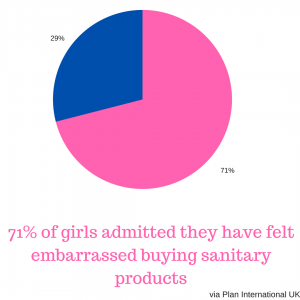
According to statistics from Plan International UK, one in seven girls have to ask a friend to lend them sanitary wear as they are unable to afford it, and one in five girls have had to change to a less suitable sanitary product as they cannot afford anything else.
Helping to tackle this issue in Islington is the Tricky Period Project. “We are currently piloting a scheme with Islington Libraries where women have free access to the sanitary products that they need,” says Sophie Marsh, who oversees this project. “We collect donations of period products and help to signpost people to the libraries. We also give out sanitary items when we do food outreach in the evenings.”
“We know that the problem is prevalent in Islington because on a day-to-day basis we see women come to our day centre who cannot afford life’s basic necessities – food, clothes and period products.”

When Value Added Tax was first introduced in 1973, sanitary products were taxed at the standard rate of 10%. In 2001, the tax on sanitary products was then reduced to 5% by the Labour government, as, according to EU regulations, this is the minimum rate that can be charged.
Since then, the rate hasn’t increased, but this still hasn’t solved the problem. “The period poverty problem has been exacerbated because period products remain hugely expensive for many people. Research has shown that other necessary items such as food are often prioritised over buying sanitary care,” Marsh says. “Many women and girls resort to using old rags or clothes instead of other period products, exaggerating the shame and anxiety that is still attached to menstruating.”
Back in 2015, a petition was created asking the government to make sanitary products VAT-free. It managed to gain over 320,000 signatures. This then prompted the government to start talks with the EU over introducing a zero tax rate on these products during a discussion on VAT rates in 2016. Since then, the European Commission have said they are aiming for sanitary wear to be sold tax-free, but in the meantime they continue to be taxed at the normal rate.
Although the tax rate can’t be changed, some UK supermarkets have done their bit to help. Back in July 2017, Tesco decreased the price on almost 100 sanitary products. Then, a month later, both Morrisons and Waitrose also slashed prices on some of their menstrual-related products.
This is also a prominent issue for homeless women, who struggle with finding safe and clean facilities:.“Access to safe and hygienic places where women can change pads and tampons remains limited, especially for homeless people, resulting in infection.” says Marsh.
“We hope that by establishing safe and stigma-free points of access to sanitary products, both at our day centre and at the local libraries, we will be able to help the women who are perhaps foregoing these products in silence.”
The Homeless Period initiative also helps to tackle this problem, by taking donations of all types of sanitary wear for homeless shelters, and even ran a petition so shelters can have an allowance for period-related products.
Another group of people affected by this widespread issue are refugees and asylum seekers. The Bloody Good Period was set up when their founder, Gabby Edlin, realised enough wasn’t being done to help this group of women when it comes to having access to sanitary products.
“At Bloody Good Period, we collect menstrual supplies for Asylum Seekers and Refugees. We then supply drop-ins around London mostly where refugees and asylum seekers can pick them up at the same time place they pick up clothes and other everyday essentials,” says Alice Walker-Mitchell, Volunteer Admin and Tech Coordinator. “This creates reliability so no one has to worry about not having something when their period comes. We get donations through collections, our Amazon wishlist and occasionally from corporates.”
Bloody Good Period feel this problem has always existed, but with it suddenly coming to light over the last few years, it’s a better time than ever for changes to be made. “It’s always been an issue, but it’s only now coming into the public forum,” says Walker-Mitchell. “Asylum seekers are given an allowance of £37 a week to live on, which doesn’t stretch very far, and unsurprisingly given the choice between food and period products, most people would choose food.
“Not enough is done to tackle it, the government could easily either provide menstrual products for free or up the weekly allowance to include the cost of menstrual items.”
Helping to educate young people about this issue is the Betty For Schools programme. Travelling around to visit primary schools in London, including Holloway School, their facilitators run workshops to help break the taboo and reinforce the message that it’s “perfectly natural”.
Although this is a step in the right direction, there is still plenty of work to be done to both break the stigma, and help those who are in need.
“Women and girls miss school, work and social activities because of the negative associations and stigma still attached to periods,” says Marsh. “Although individuals and organisations are working hard to highlight and tackle the problem, the fact that many women still do not have access to the products that they need shows that a lot more needs to be done.”
Sanitary wear brands are playing their part in helping. ALWAYS have been donating products to the charity In Kind Direct for over 14 years, and, through their ALWAYS & TAMPAX Puberty Education Programmes, they provide sanitary pads to schools across the UK. Additionally, Mooncup Ltd have worked with Boots to provide store donation points where people can purchase and donate period-related products.
The UK government have passed legislation allowing for sanitary products to be sold with zero VAT added on top, but cannot do so until the European Commission officially change this rule. Until then, the many UK charities continue to do all they can to end period poverty, both here in the UK, and all over the world.
[jwplayer mediaid=”17910″]
For more information on the charities mentioned, please visit:
https://bettyforschools.co.uk/
https://www.islington.gov.uk/libraries-arts-and-heritage/libraries
https://www.bloodygoodperiod.com/
To donate, visit: www.justgiving.com/fundraising/bloodygoodperiod
Or send unopened packets of pads to:
Bloody Good Period, SafeStore, Alexandra Palace Way, London N8 7HP
Leave a Reply