
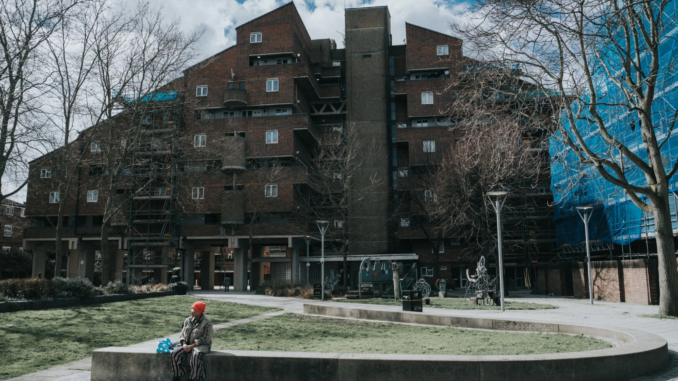
Photo of Andover Estate. Credit: Adam Rowley
By Jade Lennon and Leo Ward
The Talking Drum: voices by the Andover estate, promoted by London Metropolitan University and directed by Tony Graham is an exclusive one-week production on the lives of residents on Holloways unfavoured estate.
“As soon as people hear our postcode, we get labelled. That is the hardest thing living on the estate – that label” – The Talking Drum says.
Known as the concrete jungle, the estate Dibdin House is a 10-storey high block of flats in a pyramid shape with 61 households. Built and completed in 1979, Dibdin house took an architectural reputation on the Andover estate for its unique character and was at first well liked for its indoor plumping per flat, which was revolutionary compared to the older “slum styled” houses of the time.
However, 15 years ago, the entire Andover estate first hit headlines for its bad reputation when the late MP Ann Widdecombe made a documentary on the conditions of the estate. Following the documentary, the estate residents were branded as hoodies. People on the estate still face issues over drugs and negative behaviour and residents say that there is fear built into the name of the estate.
Minoritised residents of the area are also subjected to different treatment compared to other areas. Reon, a teenage resident of the estate, is not unaware of the sound of sirens on the estate. He believes that people see Black teenage boys and think based on how they walk and talk, police regularly conduct stop and searches when he doesn’t believe there’s a reason.
Residents on the estate fall to classism and judgement of their lifestyle just by admitting to living on the estate, treated like criminals based on where they call home.
‘If I’m chatting to someone online and they ask where I’m from, they kind of respond “ooh” when I say Andover Estate. Like they’re a bit scared, or something,” Reon told Metro.co.uk.
With a lack of areas on the estate for young adults and teens to meet safely and do activities, many turn to crime easily, from doing drugs to selling them. However, The Talking Drum shows how strong the community is within the estate trying to turn their reputation around. The youth club on the estate is trying to do its best to protect the future of the children on the estate and give them opportunities.
London Metropolitan University and the Park Theatre have collaborated with the Andover Estate community centre to produce The Talking Drum to captivate the sense of community on the estate.
But how was this play written and why?
John Gabriel, an emeritus professor at London Metropolitan University and chair of the UK Oral History Society was the project lead on the oral history project ‘Life on the Andover Estate’along with Dr Alya Khan and Gulser Rose Kaya. This is a method of “gathering and preserving historical information through recorded interviews with participants in past events and ways of life”, according to Keele university.
For this project, Gabriel interviewed forty residents that live on Andover estate about life on the estate. After talking with Tony Graham, a freelance theatre director known for creating and running the new unicorn theatre at London Bridge, they decided to turn the “interviews into a dramatic performance”, said Gabriel.
The play starts off with music with an African drum playing in the background as all of the local figures are introduced to the audience. These characters include Elena, a retired ballerina who finds herself homeless, Gary; a youth worker who struggles against stereotypes at university, resident ‘007’ who can’t get the council to listen to their concerns, NJ who dreams of being able to play the African Drums, Ashley; a single mother and Dave who struggles with addiction.
This sets the scene for an interactive and heartfelt performance that portrays what it’s like to live on an estate, specifically Andover estate.
The play follows these characters and how they overcome these struggles, exploring what day-to-day life looks like for people living in an estate.
The Talking Drum was described as ‘incredibly powerful’, relatable and a ‘magnificent piece of theatre’ by members of the audience.In theatre, portraying a clear message is important as this creates a shared experience between the audience building an emotional connection.
Gabriel expressed how he wanted to ensure that “people were listened to by a wider audience”, to have their voices and opinions heard as during the project interviews many residents voiced how they felt ignored and that people weren’t listening to them.
This is the main theme that is apparent throughout the play with all the characters.
They are all ignored, feelings dismissed. Gary suffocates in stereotypes and labels for attending university as working class. Elena is overlooked by society’s safety nets causing her to become homeless.
Resident ‘007’ repeatedly tries to hold the local authorities responsible for their actions but the council are ignoring his concerns and NJ finds trouble breaking through into her passion.
“You need to live here to understand living on an estate”, The Talking Drum says. Throughout the play, it is clear that living in an estate is stigmatised and labelled by the people living outside (the estate). This is because of the negative press that the estate receives. Gabriel expressed how there is “ a lot of negative coverage”.
The main topics that frequently appear about council estates are vandalism, crime, knife crime, murders and mold. This creates a detrimental representation of Andover estate and other estates in London.
Community is important as this can reduce stress and isolation, provide support, knowledge and networking opportunities. Community spaces include green spaces such as parks, community centres, food banks and more.
Community in Andover Estate
Feedback from residents is mixed with some feeling the “loss of community” while others feel that there’s a “sense of community of people talking to each other, working with each other”, John expressed. With many residents greeting each other regularly, some haven’t ventured into the whole estate.
Ran between August 19 and August 29th of 2026, this theatrical display of interwoven interviews counteracts the negative media that the Andover estate and specifically dibden house have received.
The production shows these are real people with real lives and human feelings who do not deserve to be subjected to the opinion and judgement of others around them. This production really captures multiple perspectives from 4 residents that the show focuses on, beating the stereo type that they all come from the same circumstance. Anyone can end up in a place like the Andover estate, if you travelled the world and had a successful life, one tragic relationship can cause a downspire of mental health causing you to end up in the andover estate, or maybe you never had a real chance to only focus on yourself and your career due to the nature of life.
Life is unpredictable and sometimes cruel to people who do not deserve it and that judgement should not be put onto them, it could happen to anyone including you.
But like the show said, life is like a boxing ring and we all fall to the floor, but we always grab the ropes once again, it just takes some people longer and no one should be judged, and that is what the Andover estate and the Talking Drum teaches us all.
Leave a Reply