

By Rose Blanchard
In 2015, the UK government boasted that they had taken on 20,000 Syrian refugees, following the civil war that began in 2011.
Six years on, Health Minister Sajid Javid says the UK is preparing to take on “hundreds of thousands of Ukrainians”.
Many people have taken to social media platforms such as Twitter, Facebook and Instagram to air their frustrations – claiming that a racist narrative is underpinning the difference in response to Ukraine, compared with countries also facing humanitarian crises such as Afghanistan, Yemen and Syria.
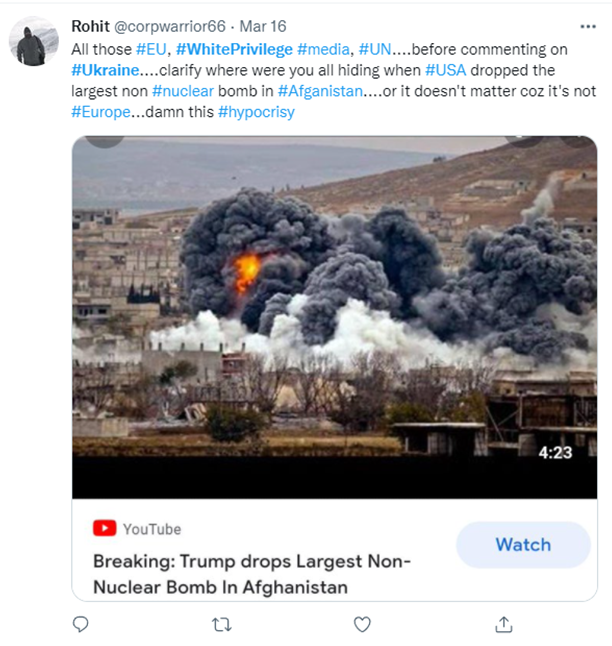
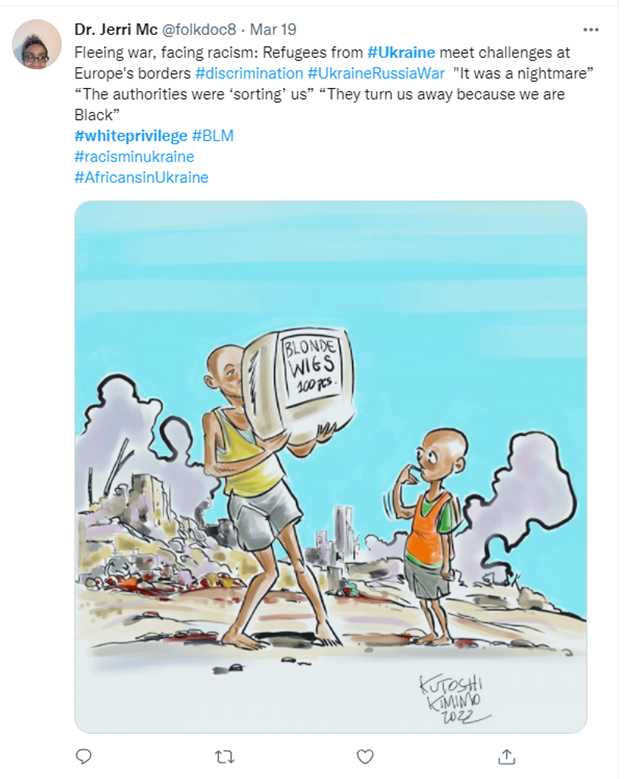
Many users have also highlighted that people of colour living in Ukraine, particularly students from African countries, are being “sorted” at Europe’s borders, with white people able to flee whilst they are being turned away.
One user posted:
Guardian journalist Moustafa Bayoumi pointed out the “racist” war coverage in Ukraine earlier this month, highlighting CBS Senior Foreign correspondent, Charlie D’Agata, referring to Ukrainians as being “civilized” in opposition to previous refugees from places “like Iraq or Afghanistan”, seemingly implying they were somehow more deserving of sympathy.
This comment was later retracted.
Others, such as the Middle East Eye website, emphasised how comparisons between Ukraine and the Middle East had exposed white privilege and given a platform to racist views and opinions.
‘They are like us’
Emad Odeh is the grandson of Hasan Anes Odeh, who fled from Palestine in the 1960s. Hasan became a refugee in Jordan where he made a family and a home. Emad was raised in Jordan but has been living and studying in the UK on and off for the last three years.
“Some journalists on English and American channels saying that ‘I feel sad for Ukrainians because they are white with blue eyes and blonde hair, and some of them are saying that ‘they are like us,’” Emad Odeh told the Holloway Express.
“I don’t expect the same reaction from them [English and American Media outlets] because they are trying to react targets.” He implied that it is in English and American interest to be against Russia, and that they have no interest in the Middle East because it doesn’t affect them.

Really complex
International Relations expert Andrew Moran told Holloway Express: “I think the response is really complex actually. If you think about countries like Germany, they willingly accepted people from the Middle East as did a number of other countries.
“A lot of the migrants from the wars in Syria are now in Turkey, they’re in Jordan, a lot of them are in Europe and they were welcomed relatively openly to begin with until the backlash from populist-inspired movements fuelled by fears of terrorism, fears of people taking jobs away.
“You have that against the backdrop of economic problems building after the crash in 2008 in this country. You had austerity, which was very aggressive, and migrants were manipulated within that as to the reason you can’t get a bed in a hospital or a place in a school is because there’s a migrant taking your place. So, we see that hostility in this country, people on the right, people in the government peddle this.
“I think it’s too easy to say the reason that we are all embracing Ukrainians is because they’re not from the Middle East.
“It’s because they are from Europe, because Europe is closer than the Middle East. Some Europeans have a relationship with Ukraine.
“Europeans travel around Europe; they don’t travel around the Middle East. There is more of a willingness because there is more of a fear that the war in Europe will spread so war can we do, we’re all helpless.
“We can’t stop what Putin is doing. Because if we try and stop what Putin is doing, that could escalate very quickly.
“How can we help? Well, we can help, by helping the people who are being brutalised by the Putin government. So, I think that is feeding into the sense that that is one of the things, we, the British public, can do. I think that is fuelling the, in my opinion very positive response from people across Europe.
“In amongst it, it is layered for some people. In the case of Syrian refugees, Iraqi refugees, refugees from Libya and elsewhere. There was a feeling in some that we don’t want these people here, these people could be terrorists, these people are different in their cultural values, their religious values whereas Ukrainians are more familiar in a sense.
“It’s very difficult to walk across this terrain because everyone is having their own individual experience.”
‘It’s a human imperative’
Many British families have been signing up to take in Ukrainian refugees. Making space in their homes to accommodate those fleeing the country.
Journalist and London Metropolitan University Lecturer Wendy Sloane has recently finished all the paperwork and is planning on welcoming two refugees, a mother and son, into her family.
When asked if she had any anxieties about her decision, she responded: ‘Funnily enough no, which is strange because normally I would… but no.”
“I have the space and I feel like I need to. It’s a human imperative.”
Leave a Reply