
Live Blog: Why Food Banks?
By Bhargav Patel, Carmen Garcia, Michelle Sit Aboha and Tsvetelina Stancheva
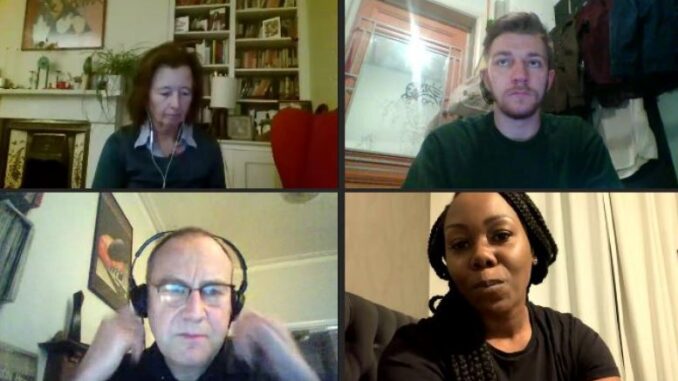
Why Food Banks? This is the question leading the debate at London Metropolitan University this evening with Journalism students, staff and guests.
Today’s speakers make up a distinguished panel from various charities across London including Tiffanie Cummings, healthcare worker and mother of three; Solomon Smith and Dr. Mahamed Hashi of Brixton Food Kitchen; Carmel McConnell MBE, founder of Magic Breakfast; Leon Aarts, founder of With Compassion; Anne Elkins of The Felix Project and Morven Oliver-Larkin of the London Food Poverty Campaign.
16:55: The guests are preparing for the discussion from their remote locations. Staff, students and guests wait for the remaining panel members to join
16:58 Journalism Course Leader Wendy Sloane talks about her experiences volunteering with various charity organisations and brings humour, welcoming her mother based in San Diego as the oldest guest
16:59 “The fact that some people, including children, don’t have enough to eat is disgraceful in a country as rich as the UK. We all know how food insecurity, especially amongst children, has been made worse by the pandemic,” Sloane says
17:00 The event has properly started now
17:08 Wendy Sloane introduces Hungry London Event
17:09 Senior Lecturer Simon Cadman, who is hosting the evening, introduces the panel
17:10 Tiffanie introduces herself
17:11 Question from student Ryan Gray: What are your thoughts on the government’s £30 food parcels, which actually contained less than £6 of food?
17:12 Tiffanie responds to the question and says how difficult it is feeding two children who are at school
17:16 Anne Elkins wasn’t satisfied by the new scheme and the quality and quantity of the meals. She feels more can be done “What is the government doing? Any organisation that provided food before Covid, if they’ve remained open, is now a foodbank,” she says
17:18 Carmel McConnell MBE shared her respect for Tiffanie’s experience
17:21 Dr. Hashi talks about his response to food poverty issues with a limited budget
17:24 Dr. Hashi speaks to Solomon Smith, who works alongside him at Brixton Soup Kitchen, about their struggle to get the support they need. “The Soup Kitchen has been running for eight years and never received core funding. It’s so important that we put ourselves forward to take on responsibilities…we need to be at the table when decisions are made.”
17:27 Question from student Gianluca Baarbazza: Is food considered a privilege?
17:29 Leon Aarts says having food is a human right
17:31 Carmel McConnell agrees
17:34 Dr. Hashi talks about why he became a council member and his experience
17:37 Morven Oliver-Larkin talks in more detail about food being a basic human right
17: 40 Tiffanie says she is grateful. She has been fighting on the frontline during the pandemic in a care home
17:41 Carmel shows gratitude to Tiffanie fighting in the frontline
17:42 Question from student Florentina Cercel: Has Covid-19 affected the number of people who use food banks?
17:44 Anne Elkins talks about how the pandemic has increased the need for food banks
17:49 Leon Aarts says With Compassion is a new food bank that was founded due to the pandemic, and that he found it hard to get food and support
17:51 Simon Cadman: How hard is this work while people are feeling at their lowest?
17:52 Solomon Smith answers the question, talking about how his soup kitchen runs and its value
17:57 Carmel talks about being from a rough part of London, and how hard it is to provide for children who need food and other necessities. “We have the highest daily Covid rates and the highest level of hunger across the developed world. If not now, when? We are seeing destitution at a level never seen before. This is a heart-wrenching time.”
18:01 Question from student Maame Takyi: Do food banks in London only cater to homeless people and families? How has the profile of people who use them changed due to the pandemic?
18:02 Morven Oliver-Larkin answers. “Due to the pandemic, there has been an increase in needing food.”
18:05 Anne Morven agrees with Morven Oliver-Larkin stating there has also been a struggle to get food for those who need it.
18:08 Dr. Hashi says the pandemic has affected everyone, but has brought many people together. That common struggle and sense of cooperation however, has not been shared by the government
18:10 Question to Tiffanie from student Lamin Jaiteh: Given that a steady job and a regular income aren’t enough to stop you from falling into the food poverty bracket, what has that done to your personal pride?
18:11 Tiffanie Cummings explains having grown up experiencing food poverty and how her life has changed since, but that those values remain
18:13 Question from student Vicky Calabrese: How has poverty impacted children’s well being?
18:14 Leon Aarts says it is hard to understand. “Children who go to school hungry – they can’t concentrate well, study well, do their work well. If that goes on for a longer basis it affects mental health.”
18:15 Tiffanie Cummings says her children are okay, but that her understanding of food poverty has encouraged her to keep fighting to end it
18:18 Carmel McConnell says how supportive she is of Tiffanie before talking about Magic Breakfast. “I started Magic Breakfast 20 years ago when I realised children were going to school hungry. I started dropping off food – within a month I had 50 schools… 8,000 children needing breakfast, lunch, food for holidays.”
18:22 Question from student Carolina Piras: How has one of the world’s richest cities ended up in need of food banks?
18:23 Leon Aarts says: “We have the biggest group of billionaires living here… what we have lost is our humanity, when you keep it for yourself in fear that someone else will take it.”
18:29 Question from student Claudia Schergna: Do you have options for people who have food allergies? Dairy-free/gluten-free can often be too expensive for families…
18:30 Anne Elkins points out that food banks have limited sources, but do the best they can to accommodate
18:31 Dr. Hashi says he understands the struggle with food requirements. Being Muslim, he only eats Halal food
18:32 Carmel McConnell suggests a food bank called Banquet
18:33 Question from student Rhanie Al-Alas: If food parcels aren’t working, what is a better alternative?
18:33 Carmel McConnell says it is difficult to give food to many schools and make sure they are all getting adequate meals or parcels
18:34 Anne Elkins expands on Carmel Mcconnell’s point. She explains there is not a simple answer
18:35 Question from student Nikos Papanikolaou: What will the impact of Brexit be on food prices and people on low incomes?
18:37 Carmel McConnell says that food banks will continue to try to find the right sources and give out as much food as possible
18:38 Nikos continues: How will food be affected by Brexit in terms of quantity or quality?
18:39 Morven Oliver-Larkin says it has been okay so far, but she expects there will be some problems later on, like delays or higher prices for example
18:41 Question from student Thaddeus O’Connor-Dunphie to Carmel McConnell: You said in a Ted Talk in 2015 your aim was to reach half a million children – how close are you to your goal?
18:42 Carmel Mcconnell says “We are now feeding four times the amount of children we were feeding back then so we still have progress to make”
18:47 Question from student Thomas Hughes: Do we rely on food banks too much, making people dependent on them?
18:48 Anne Elkins explains that people should be able to depend on the government, not food banks. The recent increase in use of food banks will hopefully return to normal after Covid
18:51 Question from student Sophia Wright: Is there a common backstory for the people you help?
18:52 Leon Aarts “There are many different reasons someone may need food.” He discusses the issue of homelessness in London and across the world and how that impacts food poverty rates
18:58 Tiffanie Cumming explains politicians have to be understanding of those who have faced poverty. “Or we need to become politicians.”
18:59 Conference ends
19:00 Wendy Sloane thanks all the panelists and guests
Leave a Reply