
By Leanne Powell

Coronavirus has caused devastation throughout the UK and around the world and has also had a huge impact on the use of foodbanks in the UK more now than ever before. Getting enough food was difficult for many prior to the pandemic, but it has made things much harder for families, individuals, and foodbank volunteers.
More than two million people have applied for Universal Credit benefits since lockdown commenced, this compares to a weekly average of 52,000 applications prior. Thousands of households are suffering from either job losses or smaller incomes due to being furloughed.
To make matters worse, people are not only struggling to afford food but are also struggling to gain access to some staple food items such as rice, flour and yeast, after encountering empty shelves after queuing for hours on end.
“Not being able to get hold of everyday items to ensure I could make my daughter meals made me really anxious,” said Jenna West, 32, a personal assistant and mum of one from London.
“Luckily, I returned to work part time six months before the lockdown, so having an income as well as working tax credit allowed me to be able to shop in M&S, which is quite expensive – but they were the only shop that was relatively well stocked compared to others.”
West adds that if she had been on benefits, she would not have been able to afford M&S prices. “I would have felt like I failed my child. I have never turned to a foodbank for help, but the thought was in the back of my mind because I never knew where the coronavirus was going to take us. Especially as I have only recently started my job and saw so many job losses.”
Turning to the Trust
The Trussell Trust is one of many foodbank providers and one of the largest, with over 1,200 outlets within the UK. Their aim is to help “end hunger and poverty” by giving support to local communities who are struggling for food and drink. They provide struggling families or individuals with food hampers full of healthy and nutritious goods or non-food items that can last up to three days.
But after seeing a rise in the need for foodbanks since the pandemic began, the trustees say they are beginning to suffer from the daily pressure for their services, combined with a lack of food donations coming through their doors. The Trust has called on the government for help after the high demand.
“We need emergency measures to ensure people can makes ends meet during this crisis. We have the power to come together as a country and make sure support is there to stop any of us being swept into poverty during this emergency,” the Trussell Trust’s chief executive, Emma Revie said in an interview with the Guardian recently.
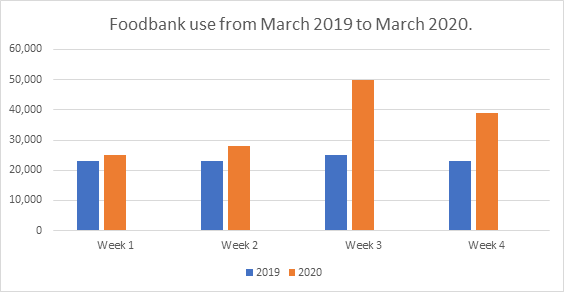
In March, the increase in the need for food parcels almost doubled compared to last year, according to the Trust, which has reported an 81% increase in demand.
A recent report from the Mayor of London said that a “shortage of food and people to run them” has resulted in some food banks being forced to close, or considering closing.
The effect of lockdown in the UK
The Tab Church is one of the largest foodbank operators in Lewisham, South London, running two-three times a week alongside The Trussell Trust. They were forced to close at the end of March due to new government regulations put in place to in force a lockdown on the UK.
Warehouse manager, Faitlyn Wallen said, “I began to notice a significant drop in daily donations at the start of the coronavirus and an increase in families coming to us for help, especially as [we’re] a church and one of the biggest foodbanks in the area.
“We get people coming to us all year round and have been through many difficulties as a church and foodbank, like when Brexit started, we noticed a drop in donations. Then around Christmas time, that is when we have a surge in people coming to us. So we have been through it all, but this has had the biggest effect on us of them all.”
Wallen said that people started coming to the Church for food after seeing the devastation coronavirus brought about in other countries. “They were worried about how they would survive this period,” she said.
“Then when myself and the volunteers were seeing the queues for the supermarkets and the lack of stock, we were worried that we would not be able to take the load. As well as worrying about how we could protect ourselves at the same time.
“As part of a church we had to close, even though it felt wrong because we also wanted to stay open and help people.”
The stockpiling in supermarkets had an effect on foodbanks, which began to struggle to provide key foods that were highly sought after such as pasta, rice, and toilet paper. When supermarkets began to limit the number of coveted items customers could buy that eased a bit, and customers continued to donate items at food collection points within stores.
Need for donations
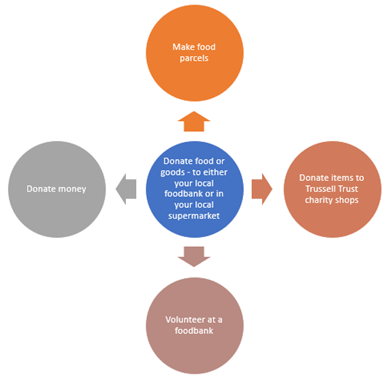
The Trussell Trust are calling on more people to donate to their cause. There are several options of how you can help donate:
Not only are they calling for food donations, but they are also asking for more volunteers to help where they can. They have also highlighted that they have put measures in place to make sure they are protecting the wellbeing of themselves and others.
These include the use of face masks, shields that lie two metres between the person in need and the volunteer, a queuing system outside the premises and pre-packed food parcels so that customers no longer gets to choose their items.
“I volunteered in the past because I enjoy helping people and giving back, especially as a younger person I have always felt grateful for everything I have but also understood other people’s struggles,” said Oliver Witcher, a former Volunteer at Vauxhall foodbank.
“I instantly knew I wanted to put myself forward again at a time like this during the crisis.”
Vauxhall is currently closed due to the pandemic, so Witcher thought of different ways to help. “I saw they were doing a delivery service instead and thought that they may be struggling for volunteers,” he said.
“I knew staff were probably having to self-isolate, people with a lack of funds may have nowhere to go for food and cannot queue for hours at the supermarket. Or those families who may fear coming out of their homes because they want to protect their own.
“Being able to drop off items to those in need is great and I am happy to do it at a time like this. It’s an organised system where I am provided with gloves and a mask and have to drop the items off at the door so have no contact with customers.
“I really enjoy it and once this is all over, I am hoping to do some more volunteering again soon.”
Leave a Reply